
Yes, most buildings, especially high-rises, condos, and managed apartment complexes, require a certificate of insurance before a mover can access the elevator or loading dock. The document is usually an ACORD 25 form naming the building as additional insured. If your building manager just asked for one, your first move is simple: request their specific COI rider today and forward it straight to your moving company's operations team or insurance broker.
TL;DR:
- Building strict requirements often demand a specific ACORD 25 form with exact wording, endorsements, and coverage limits to ensure liability transfer to the mover's insurance.
- Starting the COI process at least 7 to 10 business days before the move helps avoid rejection due to timing or incomplete documentation, especially during peak seasons.
- The correct additional insured endorsement, typically CG 20 10 or CG 20 11, is essential for liability protection; a generic certificate with only certificate holder listing is insufficient.
- Common rejection issues include mismatched entity names, missing endorsements, limits below building requirements, and expired or late-submitted certificates.
- Orange Movers handles the entire COI coordination process upfront, ensuring compliance and reducing last-minute move delays or denied elevator access.
Table of Contents
- What Is a Certificate of Insurance for Movers?
- What Fields and Endorsements Should Appear on the Document
- Why Buildings Are Strict About Certificates of Insurance
- How to Get a Correct COI for Your Move
- Timeline, Verification, and Common Failure Points
- How Orange Movers Handles Certificates of Insurance
- Why Buildings Reject Certificates of Insurance (and How to Fix It)
- Practical Framing for Apartment and Condo Moves
- Let Orange Movers Handle Your Building's COI Requirements
- Sources
- FAQ
What Is a Certificate of Insurance for Movers?
A certificate of insurance movers submit to a building is a one-page summary, not the actual insurance policy. It is issued by the moving company's insurance broker and lists the coverage types, limits, and dates in effect. The industry standard format is ACORD 25, a form recognized across the insurance world so property managers can review it quickly without reading a 40-page policy document.
Broker issuance matters more than most renters realize. A legitimate COI shows the broker's name and contact information in the "Producer" field, not the moving company's own letterhead. That distinction is one of the fastest ways to spot a problem certificate, something Mover Scorecard flags as a common red flag in its coverage of moving COIs.
A typical moving COI lists several policy lines:
- General liability covering property damage during the move
- Workers' compensation protecting building staff and residents if a mover is injured on-site
- Commercial auto for the truck making deliveries and pickups
- Cargo coverage for belongings while in transit
- Umbrella policy adding extra liability limits above the base policies
What Fields and Endorsements Should Appear on the Document
Building managers don't just glance at a COI, they check specific fields against their own requirements. Knowing what to look for lets you catch a problem before move day instead of at the loading dock.
The certificate should clearly show:
- Producer (broker) name, contact number, and address
- Insurance carrier name and policy numbers for each coverage line
- Effective and expiration dates for every policy listed
- Coverage limits for general liability, auto, and umbrella policies
- A description of operations section naming your building as the job site
- The additional insured designation, tied to your building's legal entity name
Quick fact: Property managers like Columbia Residential publish exact wording requirements for certificate holders, meaning a generic COI with the wrong entity name gets rejected even if the coverage itself is adequate.
Two endorsement codes come up often: CG 20 10 and CG 20 11. These reference the specific policy amendment that actually extends coverage to the building, separate from the COI summary itself. Being listed as "certificate holder" is not the same as being "additional insured." Only the additional insured status transfers real liability protection to the building.
Why Buildings Are Strict About Certificates of Insurance
Building managers aren't being difficult when they demand precise wording. A COI naming the building as additional insured shifts liability to the mover's policy first if something gets damaged in a hallway, elevator, or lobby during your move. Without that endorsement, the building's own insurance could be the first line of defense, and claims against it can push up premiums for every resident.
High-rise and commercial buildings tend to be the strictest, often setting coverage minimums well above what a casual mover carries and asking for the building's specific rider language rather than a generic template.
Skipping this step has real consequences:
- Elevator or loading dock access gets denied outright
- Your move gets pushed to a later date, sometimes losing your reserved time slot
- Some buildings charge rescheduling or late-COI fees
- You may be left scrambling for a mover who can produce a compliant certificate on short notice
How to Get a Correct COI for Your Move
Getting a moving company liability insurance certificate accepted by your building comes down to sequence and timing. Skip a step and you risk a rejected certificate the week of your move.
- Request the building's exact rider language. Ask your property manager or management company for their specific COI requirements, including the legal entity name, mailing address, and any required limits.
- Send that rider to your mover well in advance before move day, allowing sufficient time for processing. Forward it to both the operations team and their insurance broker so nobody is guessing at requirements.
- Confirm the broker issues an ACORD 25 with the correct additional insured endorsement and the building's name spelled exactly as required.
- Forward the completed COI to building management and ask for written confirmation that it's been accepted, not just received.
- If your mover can't produce a COI, ask for the broker's direct contact and verify the carrier's operating authority through FMCSA's SAFER system. If they still can't deliver, consider switching to an asset-based, properly insured carrier before your date gets closer.
Pro Tip: Save the building's exact rider wording as a PDF and send it to your mover the same day you book. Waiting until a week before move day is the single most common reason COIs get rejected for wrong naming or missing endorsements.
Timeline, Verification, and Common Failure Points
Brokers can often turn around a certificate of insurance in 24 to 48 hours, but building review adds days on top of that. Plan for 7 to 10 business days total between requesting the rider and getting written building acceptance, a timeline Mover Scorecard recommends specifically to avoid last-minute scrambles.
Quick fact: Many property managers require proof of insurance for movers just 24 to 48 hours before the move date, according to MoneyGeek's coverage of moving business insurance requirements, which leaves almost no room for correcting a rejected certificate if you started late.
Verify a COI is legitimate by calling the producer listed on the document directly, not a number the mover gives you separately. Cross-check the carrier's USDOT number and insurance filings through FMCSA's SAFER portal, and confirm the legal business name matches what's registered. Common failure points include mismatched entity names, missing additional insured endorsements, limits below what the building requires, and in rarer cases, outright forged certificates.
How Orange Movers Handles Certificates of Insurance
Professional moving companies often work with their insurance brokers to prepare ACORD 25 certificates with the correct additional insured endorsements before move day. Once your building sends its specific rider, the moving company typically forwards it to the broker, reviews the returned certificate for accuracy, and submits it to your property manager with a request for written acceptance.
Our coordination includes:
- Reviewing your building's exact COI rider and required wording
- Requesting the correct additional insured endorsement from our broker
- Forwarding the completed certificate directly to your building management
- Offering rush handling when your move date is close and time is tight
We handle this process regularly for apartment and condo relocations and high-rise building moves across Fort Lauderdale and the surrounding area, where strict building requirements are the norm rather than the exception.
Why Buildings Reject Certificates of Insurance (and How to Fix It)
Most COI rejections come down to a handful of repeat offenders, and nearly all of them are fixable if you catch them before move day.
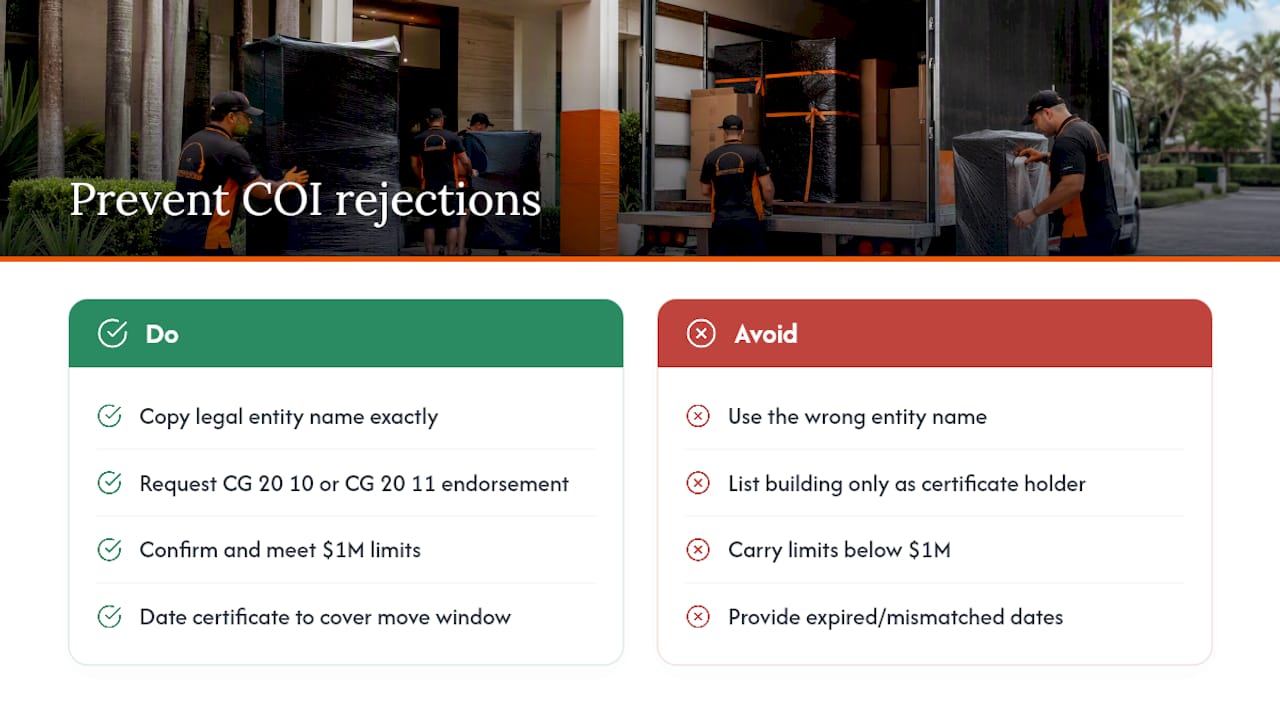
Wrong entity name. Buildings often require the exact legal name of the management company or ownership entity, not the building's street address or a shortened version. Fix it by copying the entity name character-for-character from the building's rider and sending that exact text to your broker.
Missing additional insured endorsement. A COI that only lists the building as "certificate holder" doesn't transfer liability the way most property managers require. Ask your broker specifically for the CG 20 10 or CG 20 11 endorsement, not just a certificate with the building's name typed in.
Limits below the building's minimum. Some high-rises require general liability limits of $1 million per occurrence or higher, above what a smaller mover typically carries as standard. Confirm required limits before booking so your mover's broker can adjust the policy if needed.
Expired or mismatched dates. A COI issued weeks before your move date may expire before the actual moving day. Request a certificate dated to cover your specific move window, with some buffer on either side.
Late submission. Many rejections aren't about the paperwork at all, they're about timing. A perfectly correct COI submitted two days before move day still gets denied if the building's review process takes longer than that.
Practical Framing for Apartment and Condo Moves
Building managers are not creating red tape for its own sake. Every additional insured requirement exists because a single unresolved damage claim in a lobby or elevator can raise insurance costs for an entire building, and property managers have learned that lesson the hard way more than once.
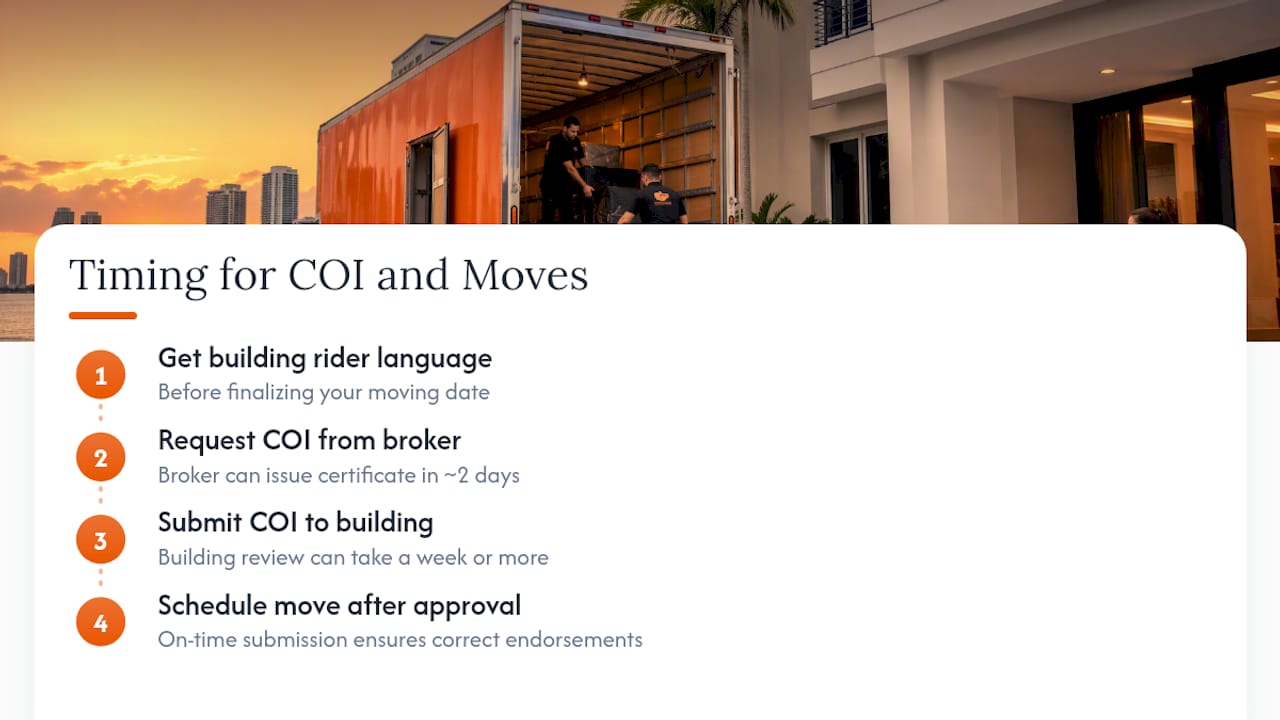
Where the conventional advice falls short is timing. Most guides tell you to "get a COI," full stop, without emphasizing that the building's review window is often the real bottleneck, not the broker's paperwork. A broker can turn around a certificate in two days. A building's front desk or management office reviewing it against their own checklist can take a week or more, especially during peak moving season in South Florida when property managers are handling multiple move requests at once.
Prioritize getting the building's exact rider language first, before you even finalize your moving date. Everything downstream, correct wording, proper endorsements, on-time submission, depends on having that document in hand early. Treat the COI request as step one of planning your move, not paperwork to handle the week before.
— Orange Movers Team
Let Orange Movers Handle Your Building's COI Requirements
Orange Movers coordinates certificate of insurance requests directly with our broker for every apartment, condo, and high-rise move we handle across Fort Lauderdale, Broward County, Miami-Dade County, and Palm Beach County.

Instead of chasing down paperwork between your building manager and a broker on your own, our team requests the building's exact rider language, confirms the correct additional insured endorsement, and forwards the completed certificate for written acceptance before your move date. If your building has a tight review window or you're moving into a high-rise with strict access rules, tell us when you book so we can start the COI process early rather than scrambling days before your move. Get a free moving quote from our Fort Lauderdale team today and mention your building's insurance requirements up front.
Sources
These sources back the regulatory and industry claims covered above, useful if you want to verify details directly with your broker or property manager.
- Certificate of Insurance (COI) for Movers: What It Is and When You Need One | Mover Scorecard
- Moving Business Insurance Requirements (2026) | MoneyGeek
- Certificate of Liability Insurance (COI) - Columbia Residential
FAQ
Do I Need a Certificate of Insurance for My Move?
If you're moving into or out of a building with a property manager, HOA, or leasing office, the answer is almost always yes. Most managed buildings, especially high-rises and condos, require a COI naming the building as additional insured before granting elevator or loading dock access.
Where Do I Get a Certificate of Insurance for My Mover?
The moving company's insurance broker issues the COI, not the moving company itself. You request your building's specific rider language first, forward it to the mover's operations team, and their broker prepares the ACORD 25 certificate with the correct endorsements.
What Does COI Mean for Movers?
COI stands for Certificate of Insurance, a one-page document summarizing a mover's general liability, workers' compensation, auto, and cargo coverage. It's separate from the underlying insurance policy and typically follows the ACORD 25 format used across the insurance industry.
How Do I Tell if a Moving Company Is Actually Insured?
Call the broker listed in the "Producer" field on the certificate directly, rather than a number the mover provides separately. You can also cross-check the mover's USDOT number and insurance filings through FMCSA's SAFER system to confirm their operating authority matches what's on the COI.