
Climate controlled storage is worth the extra cost for anyone storing wood furniture, artwork, musical instruments, photos, vinyl records, or electronics, especially for more than a few months. The core benefit is a stable temperature and, at facilities that offer it, tighter humidity control that standard drive-up units cannot match. Before you book anything, confirm the facility's exact temperature and humidity range in writing, or line up professional packing so your items are protected no matter which unit you choose.
TL;DR:
- Climate controlled units keep items within a specific temperature range, usually between 55°F and 80°F, with some facilities also managing humidity actively.
- High-risk items such as wood furniture, artwork, musical instruments, photos, vinyl records, and electronics require climate control for long-term or sensitive storage.
- Confirm whether the facility manages humidity levels specifically, as some units only regulate temperature and may not protect moisture-sensitive belongings.
- The cost of climate control increases with longer storage periods, high humidity regions, and irreplaceable items, making it a worthwhile investment mainly for prolonged or valuable storage.
- Proper packing, disassembly, and labeling are essential to protect belongings, regardless of the unit type, and should be prioritized alongside selecting the right climate control features.
Table of Contents
- What Climate Controlled Storage Actually Means
- Which Items Actually Need Climate Control?
- Heated vs. Climate Controlled vs. Humidity Controlled vs. Air Cooled
- Is Climate Control Worth the Extra Cost?
- How to Choose a Climate Controlled Unit
- Preparing Your Belongings for a Climate Controlled Unit
- When Climate Control Is Genuinely Worth the Investment
- How Orange Movers Protects Your Belongings Before and During Storage
- Sources
- FAQ
What Climate Controlled Storage Actually Means
Climate controlled storage keeps a unit within a set temperature band year-round, usually somewhere between 55°F and 80°F, though exact ranges vary by facility. That range keeps items away from the freezing cold and the attic-level heat that a standard outdoor unit swings through in South Florida.
Temperature is only half the story. Some climate controlled facilities also manage humidity control, and some don't, which is where a lot of confusion starts. A facility can advertise "climate control" and mean nothing more than indoor heating and cooling, with no dehumidifier running at all.
Facilities typically achieve this through indoor, insulated buildings with dedicated HVAC systems and, at higher-end locations, standalone dehumidifiers. Before signing anything, ask for the exact temperature and humidity range, how often the HVAC system is serviced, and whether humidity is actively monitored or just assumed to follow the temperature control. Get the answer in writing if you can.
Which Items Actually Need Climate Control?
Some belongings tolerate a hot, humid storage unit just fine. Others start degrading within weeks. The facilities that specialize in this kind of protection generally point to the same category of high-risk items, and the list holds up under scrutiny.
High priority, climate control strongly recommended:
- Wood furniture and antiques, which warp, crack, or develop mold in humidity swings
- Artwork and framed pieces, sensitive to both temperature shifts and moisture
- Musical instruments, especially pianos, guitars, and anything with a wood body or reeds
- Photographs and paper documents, which yellow, curl, and grow brittle
- Vinyl records and film, which warp or degrade under heat
- Electronics and collectible tech, where humidity drives corrosion on internal components
Conditional, depends on duration and local climate:
- Clothing and fabrics, which can mildew in humid air over long storage stretches
- Leather goods, prone to cracking in dry heat or mold in damp conditions
- Mattresses and upholstered furniture, which absorb moisture and retain odors
These aren't hypothetical risks. Extra Space Storage's own guidance on items that need climate-controlled storage lists wood furniture, electronics, instruments, fine art, vinyl, photos, and documents as the categories most exposed to temperature and moisture damage. Warping, mold, mildew, yellowing, and electronics corrosion are the most common outcomes when sensitive items sit in an uncontrolled unit for months.
Heated vs. Climate Controlled vs. Humidity Controlled vs. Air Cooled
These four terms get used almost interchangeably in storage listings, and that's a problem, because they describe genuinely different protection levels.
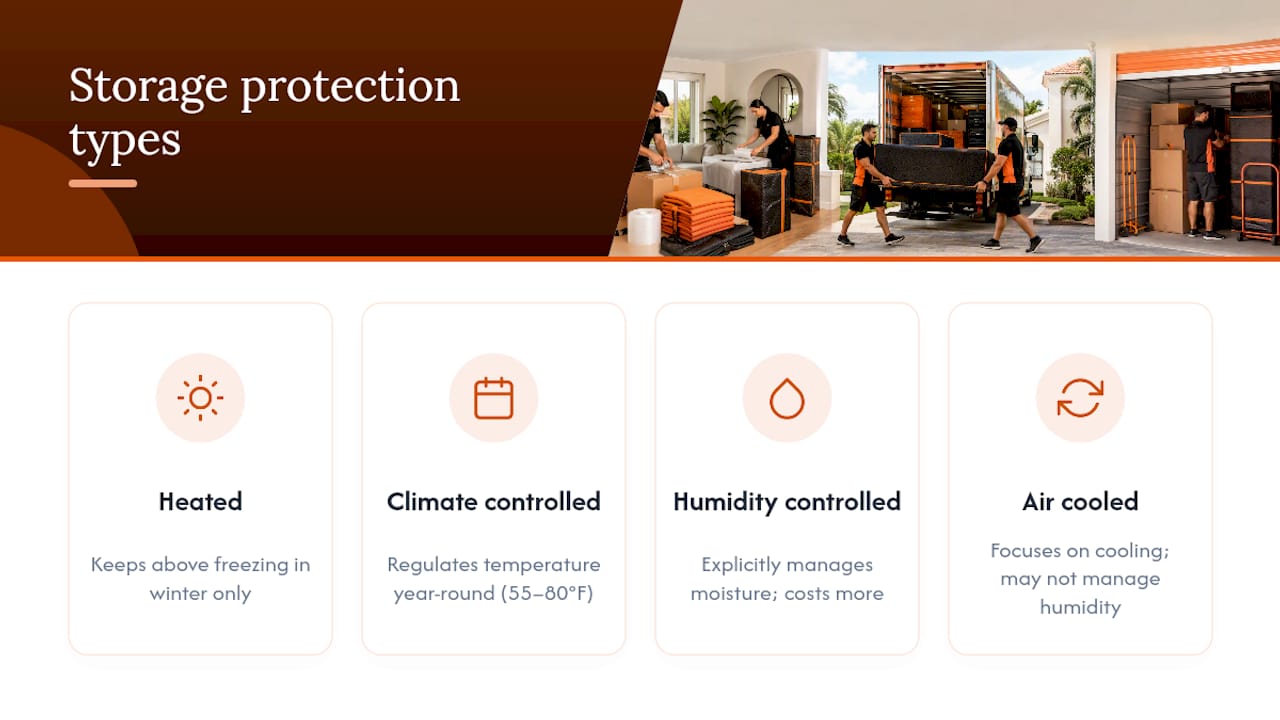
Heated storage only keeps temperatures above freezing during winter. It does nothing for summer heat and offers no humidity management, which makes it a poor fit for South Florida's climate.
Climate controlled units regulate temperature year-round, typically in that 55°F to 80°F band, but as noted above, humidity control is sometimes included and sometimes not.
Humidity controlled units explicitly manage moisture levels, which matters most for photographs, documents, and fine art. StorageMart notes that facilities offering true humidity control tend to charge more and are the better fit for high-humidity markets or long-term bookings.
Air cooled units focus on cooling in hot climates without necessarily maintaining a tight winter floor or managing moisture.
Before booking, ask directly: does this unit control humidity, or only temperature? The answer changes what you should store there.
Is Climate Control Worth the Extra Cost?
The math depends on three variables: how long you're storing, how humid your region is, and how much the items are worth to you, financially or sentimentally. StorageMart's guidance frames the decision around exactly these factors, and it holds up well in practice.
Premiums are driven by location, unit size, whether the unit is indoor or drive-up, and whether true humidity control is included on top of temperature regulation. Security features like gated access and cameras often add to the cost too.
As a rule of thumb: choose climate control for long-term storage (multiple months or spanning seasons), for storage in humid regions, or for anything irreplaceable. A short move where boxes sit for two or three weeks rarely justifies the upgrade for rugged, non-sensitive items. For genuinely short stretches, standard indoor storage paired with careful packing and adequate insurance can be a reasonable middle ground rather than paying for humidity control you may not need.
How to Choose a Climate Controlled Unit
Walking into a storage facility without a checklist is how people end up paying for "climate control" that's really just an insulated metal box. Work through this before you sign a lease:
- Confirm the unit is fully indoor, not a drive-up unit with a climate control sticker on the door.
- Ask for the exact temperature range maintained year-round, not a vague "comfortable" answer.
- Ask specifically whether humidity is monitored, and if so, what range they target.
- Request the temperature and humidity ranges in writing.
- Ask how often the HVAC system is maintained and inspected.
- Check for pest control measures, since sealed indoor units still need this.
- Review security features: gated access, individual unit alarms, camera coverage, and lighting.
- Confirm access hours match how often you'll need to reach your belongings.
Use these exact questions when you call or tour a facility: "What temperature range do you maintain?" "Do you monitor humidity, and what range do you target?" "Can I get this in writing?" "How often is your HVAC system serviced?"
Pro Tip: If a facility can't give you a straight answer to the humidity question, or hedges with "it's pretty stable in there," treat that as a red flag. A facility that genuinely controls humidity will know its numbers cold.
Watch for outdoor drive-up units advertised as climate controlled, vague or inconsistent answers between staff members, and prices that seem unusually low with no explanation. All three are signs the "climate control" label is doing more marketing than actual work.
Preparing Your Belongings for a Climate Controlled Unit
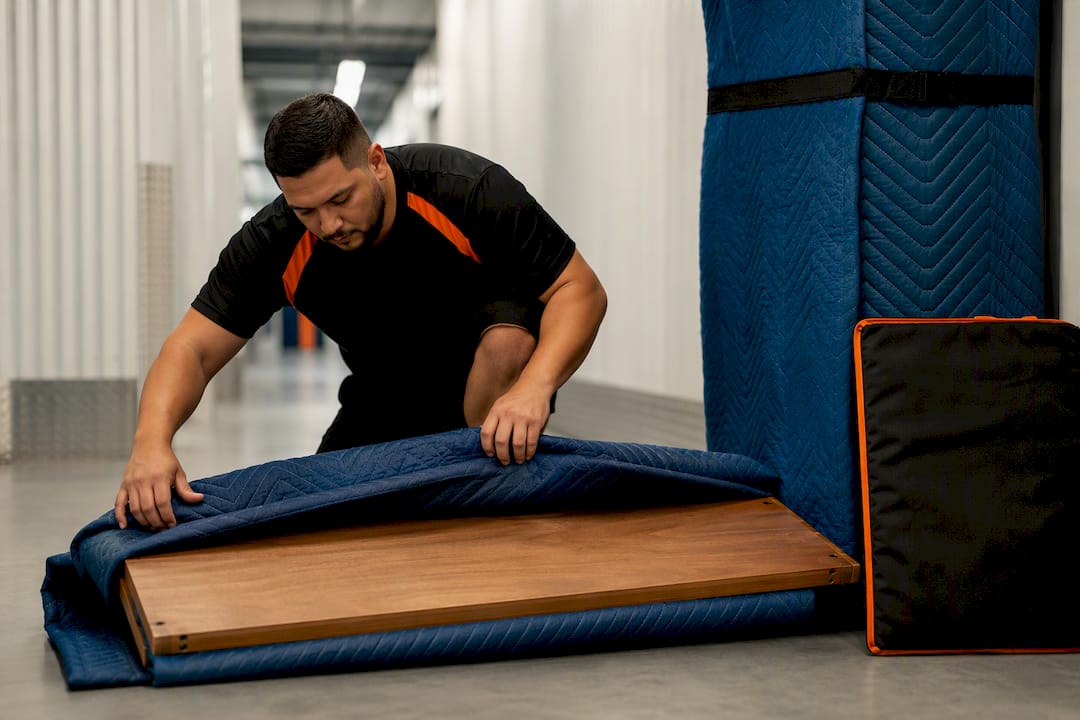
A good unit only protects what's already packed well. Clean and fully dry wood furniture before storage, since trapped moisture inside the wood grain causes problems regardless of the unit's humidity level. Disassemble larger pieces where possible and wrap them in furniture padding rather than plastic sheeting, which can trap condensation against the surface.
Store photographs and documents in acid-free boxes with silica packets or desiccants tucked inside. Keep electronics in their original boxes when you have them, or wrap them in anti-static material with silica packets added. Textiles do best in breathable covers, not sealed plastic bags.
Orange Movers' furniture padding and shrink-wrapping services apply exactly this kind of protection before items ever reach a storage unit, and packing and protection techniques like custom crating and quilt-wrapping measurably reduce damage risk during transport and storage alike. Label every box by contents and fragility level, leave a few inches of space between boxes and walls for airflow, and set a recurring schedule, roughly every few months, to check on stored items rather than forgetting about them for a year.
When Climate Control Is Genuinely Worth the Investment
The decision comes down to one question: how exposed are these items to humidity and temperature swings over the storage period? Long-term storage, humid coastal regions, and high-value or irreplaceable items point toward climate control every time. Short-term storage of durable, replaceable items usually doesn't need the upgrade.
Think about the household relocating from a humid coastal area with a piano and a box of family photos, the collector storing vinyl and vintage electronics for a year, or the small business archiving paper records in a South Florida warehouse. All three scenarios justify the premium. Before you store anything valuable, photograph its current condition and consider supplemental insurance. That documentation matters far more than people expect if you ever need to file a claim.
— Orange Movers Team
How Orange Movers Protects Your Belongings Before and During Storage
Choosing the right unit only solves half the problem. What actually determines whether your antique dresser or your grandmother's china survives storage is how it's packed, wrapped, and handled before the door ever closes on it. That's where Orange Movers fills the gap that a storage facility alone can't.

Orange Movers offers fragile-only custom packing for glassware, electronics, and collectibles, along with dedicated piano and fine art packing for instruments and artwork that need custom crating rather than a generic box. For furniture headed into long-term storage, our furniture padding and shrink-wrapping service protects wood surfaces and upholstery from scuffs and moisture exposure during transport. If you need somewhere secure to put everything once it's packed, our storage and warehousing option keeps items under professional handling rather than sitting in a garage.
Book with Orange Movers and you'll work with licensed, insured crews using professional equipment, full inventorying, and protective materials matched to what you're actually moving. Get a free quote through our local moving services page and find out exactly what protecting your belongings will cost, no guesswork required.
Sources
- Understanding the different types of climate-controlled storage | Extra Space Storage
- Selfstorage
- Climate control storage | StorageMart
FAQ
Is Climate Controlled Storage Worth It?
For long-term storage, humid climates, or items like wood furniture, art, instruments, photos, and electronics, yes, the premium is generally worth it. For short-term storage of durable, replaceable items, a standard unit paired with careful packing often does the job.
What Is Climate Controlled Storage?
Climate controlled storage is an indoor storage unit that maintains a consistent temperature, typically between roughly 55°F and 80°F, and sometimes includes active humidity management as well. Always confirm with the facility whether humidity control is included, since it varies by location.
What's the Difference Between Heated and Climate Controlled Storage?
Heated storage only prevents freezing in winter and does nothing for summer heat, while climate controlled storage regulates temperature year-round in both directions. Neither term guarantees humidity control unless the facility states it explicitly.
Can I Sleep in My Storage Unit for One Night?
No. Storage units aren't zoned or equipped for living space, and staying in one overnight raises real safety risks, including ventilation and fire code violations, and most lease agreements explicitly prohibit it.
How Long Should I Store Sensitive Items in a Climate Controlled Unit?
There's no fixed limit. For storage stretching multiple months or across seasons, climate control meaningfully reduces damage risk, especially in humid regions. For a few weeks of short-term storage, a standard unit with proper packing may be sufficient.