
If your gun safe weighs under 500 pounds, sits on a single level with no stairs, and you have at least three able-bodied helpers plus a properly rated dolly, a careful DIY move is realistic. Cross any of those lines, including stairs, tight turns, or soft flooring, and hiring professional movers is the safer call. Start by emptying the safe completely and measuring it before you decide anything else.
TL;DR:
- Safes approaching or exceeding 500 pounds require professional movers if stairs, tight turns, or soft flooring are present; otherwise, a carefully planned DIY can suffice.
- Moving equipment must include a rated 1,200-pound safe dolly, a J-bar, floor protectors, and a ramp or liftgate rated for the safe’s weight to ensure safety.
- Proper route planning involves measuring clearances, testing turn radii with cardboard templates, and laying protective runners to prevent floor damage.
- Securing the safe's door with locking tape or straps, removing internal hardware, and maintaining an upright position are essential safety steps during transit.
- Moving costs typically range from $295 to $357 for flat-ground moves, with additional charges for stairs or complex routes, and insurance coverage should be clarified beforehand.
Table of Contents
- How Do You Decide Between DIY and Hiring Movers?
- What Equipment Do You Need to Move a Gun Safe?
- How Do You Plan the Route and Protect Your Floors?
- What's the Safest Way to Actually Move the Safe?
- When Should You Just Hire Professional Movers?
- How Do You Secure a Gun Safe for Transport?
- How much does it cost to move a gun safe?
- What's on the Day-of-Move Checklist?
- What Safety Steps Protect the Safe's Door During the Move?
- What Legal Steps Apply When Moving Firearms and Gun Safes?
- Does Your Move Need Insurance Coverage for the Safe?
- How Do You Reinstall a Gun Safe After the Move?
- Orange Movers' Field Note
- How Orange Movers Handles Your Gun Safe Move
- Sources
- FAQ
How Do You Decide Between DIY and Hiring Movers?
Answer six quick questions honestly before you touch the safe.
- Weight check: Measure the safe's listed empty weight, then add roughly 5 to 10 pounds per cubic foot of interior space if it's still loaded with anything (it shouldn't be). Anything approaching or exceeding 500 pounds pushes you toward hiring pros, a threshold Liberty Safe and other manufacturers repeat consistently.
- Route scan: Walk the exact path from the safe's current spot to the truck. Any staircase, tight hallway turn, or step-down changes the calculation entirely.
- Floor type: Hardwood, tile, and soft subfloors all react differently under concentrated point loads. Carpet over concrete is far more forgiving than tile over plywood.
- Manpower and gear: Count your actual available helpers, not the number you'd like to have. Do you own or can you rent a dolly rated for the weight?
- Any doubt at all: If you're unsure about even one of these, that uncertainty is itself a reason to hire out the job.
If any answer lands in risk territory, stop planning a DIY move.
What Equipment Do You Need to Move a Gun Safe?
The right gear separates a controlled move from a disaster. Here's what actually matters, and what it should be rated for:
- Appliance dolly: Fine for lightweight safes under roughly 300 pounds, but most models max out well below what a mid-size gun safe weighs.
- Heavy-duty safe dolly: Look for one rated at 1,200 pounds or more. Professional movers rely on this rating as a baseline for any safe move, according to MovingByDesign's safety guidance.
- Motorized stair climber: Required for any safe over 300 to 400 pounds that has to go up or down even a few steps.
- J-bar: A pry tool that lifts one edge of the safe just enough to slide the dolly plate underneath without lifting the full weight by hand.
- Ratchet straps (rated, not bungee cords), mover's wrap or moving blankets, plywood or masonite runners, corner guards, and non-slip sliders for pivoting on hard floors.
- Vehicle: A ramp or liftgate rated for the safe's weight, plus a truck bed rated well above that figure with proper anchor points.
Pro Tip: Renting a 1,200-lb-rated dolly for a weekend typically costs less than one emergency floor repair, so don't skip this line item to save $40.
How Do You Plan the Route and Protect Your Floors?
Most DIY safe moves fail not because people lack strength, but because nobody measured the turn radius before starting. A safe that clears a doorway can still get wedged solid rounding a hallway corner, a mistake even experienced haulers make according to Liberty Safe's moving guidance.
- Measure the safe's width, depth, and height, then add the dolly's footprint to get the true traveling dimensions.
- Allow a minimum clearance of 2 inches on each side through every doorway and hallway pinch point along the route.
- Calculate the turn radius at every corner. Cut a cardboard outline matching the safe-plus-dolly footprint and physically walk it through the tightest turn before moving anything heavy.
- Lay plywood or masonite runners along the entire path, taping seams so nothing shifts underfoot.
- Install corner guards at every doorway edge and wall corner the safe will pass. MovingByDesign notes rigid runners distribute the safe's point load across a wider area, which protects finished floors far better than furniture pads alone.
Skipping step 3 is the single most common reason DIY moves stall halfway through a hallway.
What's the Safest Way to Actually Move the Safe?
Sequence matters as much as strength here. Rushing any step below increases the odds of a tip, a dropped corner, or a cracked tile.
- Empty the safe completely. Remove every firearm, magazine, and valuable before you move anything. This isn't optional, and it's the first rule every manufacturer guide repeats.
- Secure the door. Lock it or tape the bolt mechanism so it can't swing open mid-move, then wrap the entire safe in moving blankets and mover's wrap to protect the finish.
- Position the dolly. Use the J-bar to lift one edge, slide the dolly plate underneath, then center the safe on the plate before strapping it tight with two ratchet straps at different heights.
- Assign roles clearly. One person operates the dolly, one or two stabilize the safe's sides, and one spotter watches the route ahead and calls out obstacles. U-Haul's moving guide walks through this exact loading sequence.
- Keep the safe upright. Never exceed a slight tilt when maneuvering; a safe that tips past its center of gravity on a dolly is nearly impossible to catch.
Professional crews handle stairs differently than most DIYers assume: rather than tilting a safe down a staircase, they use motorized stair-climbing dollies that walk the safe down tread by tread under controlled power, keeping it level the entire descent. That single piece of equipment is why manufacturer guidance consistently flags stairs as a hire-a-pro trigger regardless of a safe's weight.
When Should You Just Hire Professional Movers?
A handful of conditions make hiring the obviously smarter move, not just the safer one.
- The safe weighs more than 500 pounds, a threshold multiple professional guides use as the cutoff where injury risk climbs sharply, per 3 Men Movers' safety breakdown.
- The route includes any stairs, even a short flight.
- Hallway or doorway turns are tighter than your cardboard test allows.
- Your flooring is soft, uneven, or a finish you can't risk damaging.
- You don't have three or more helpers, or you can't source a dolly rated for the actual weight.
Before booking anyone, ask these exact questions: Do you regularly move gun safes? What's your typical crew size for this weight class? Do you carry stair-climbing equipment or motorized dollies? Do you provide floor and doorway protection? Are you licensed and insured for this type of move? Is a liftgate available on your truck? What's the estimated cost and time window?
A qualified moving crew should answer all seven without hesitation. Vague answers on insurance or equipment are a red flag worth walking away from, a point echoed in independent guidance on hiring professional movers for safe relocations.
How Do You Secure a Gun Safe for Transport?
Loading a safe onto a truck without a plan invites shifting, which can crack flooring, damage the safe's finish, or worse, tip during transit.
- Position low and centered. Place the safe against the truck's front wall, low in the load, never stacked on or against lighter items that could crush.
- Double-strap at different heights. Use at least two rated ratchet straps anchored to the truck's rated tie-down points, one near the top and one near the base, to prevent both tipping and sliding.
- Match ramp to load rating. Confirm your ramp or liftgate's weight rating exceeds the safe's actual weight before rolling it aboard; an underrated ramp can buckle mid-load.
- Reverse the sequence to unload. Re-lay your plywood runners and corner guards at the destination before the safe comes off the truck, then walk the same measured route in reverse.
Single-item heavy transport services exist specifically because this step is where most preventable damage happens.
How Much Does It Cost to Move a Gun Safe?
Local safe moves typically fall in a fairly predictable range, though your final number depends on a few clear variables.
- Baseline cost: Marketplace data puts typical local safe-moving jobs around $295 to $357 for straightforward, flat-ground moves, according to Moving Help's cost breakdown.
- Stairs or complexity: Add $100 to $200 or more when stairs, long carries, or tight access are involved, since these require additional equipment and crew time.
- Crew size and equipment rental: A heavier safe requiring a fourth crew member or a stair-climbing dolly rental pushes costs up accordingly.
Time-wise, a flat-ground, single-location safe move often wraps in under an hour with a proper crew. Add stairs or a long carry from the truck to the safe's final spot, and that window can stretch to two or three hours. Weigh that cost against the alternative: a cracked tile floor, a gouged doorway, or an ER visit from a dropped corner tends to cost far more than the professional quote you were trying to avoid.
What's on the Day-of-Move Checklist?
Run through this before a single person touches the safe.
- Safe is completely emptied and door is locked or taped shut
- Crew confirmed and roles assigned (dolly operator, stabilizers, spotter)
- Plywood runners, corner guards, and floor protection laid along the full route
- Straps, J-bar, and rated dolly staged and ready
- Truck ramp or liftgate tested and confirmed rated for the weight
- Safe re-anchored and leveled immediately after placement
Pro Tip: If even one item on this list can't be checked off the morning of your move, that's your signal to cancel the DIY plan and call in professionals instead of improvising.
What Safety Steps Protect the Safe's Door During the Move?
The single most overlooked step in DIY gun safe moves is securing the door itself, not just the safe's exterior. An unlocked or unsecured door can swing open mid-transport, shifting the entire weight distribution and turning a controlled move into an uncontrolled one.
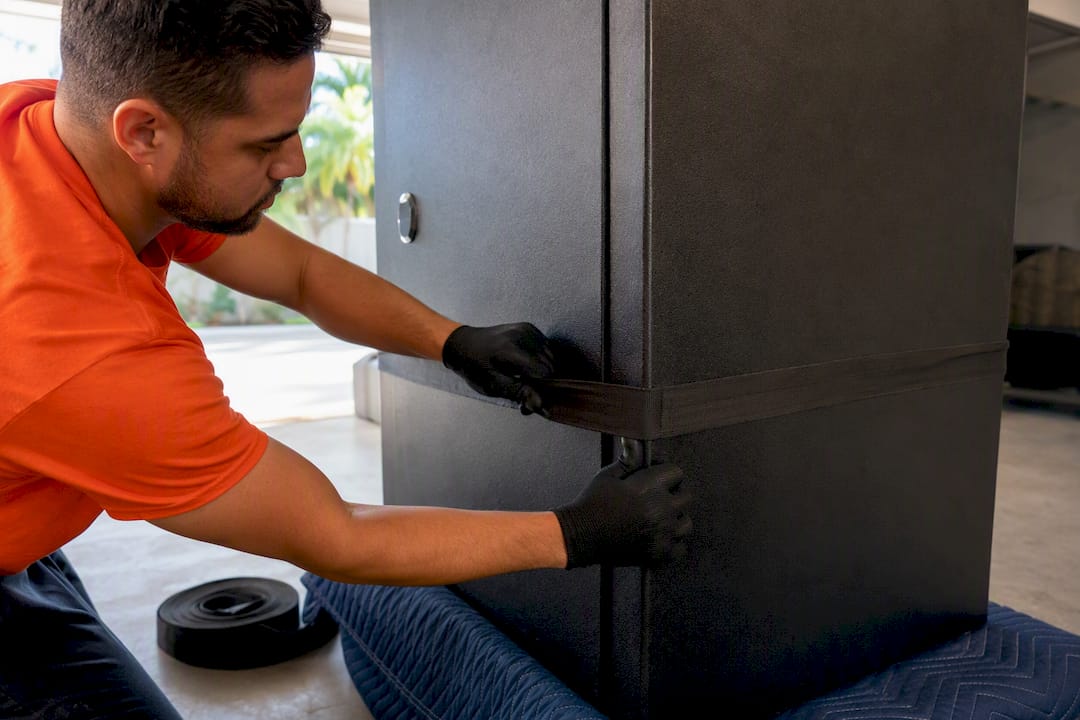
Start by locking the safe normally, whether that's a mechanical dial, electronic keypad, or biometric lock. Once locked, run a strip of painter's tape or a moving strap across the door seam itself, anchoring it to the safe's body on both sides. This adds a physical backup in case the internal locking mechanism experiences vibration-related slippage during transport, which does happen on longer moves over rough pavement.
Next, check for any loose internal shelving, removable racks, or accessory mounts inside the safe. Even with the safe emptied of firearms and valuables, factory shelving can rattle loose and shift the safe's internal balance during tilting or dolly transitions. Remove what you can, and secure what you can't.
For safes near the upper DIY weight limit, some owners and professional crews remove the door entirely before the move, along with heavy internal hardware like bolt-work plates. This lowers overall weight and reduces tipping risk during tight maneuvers, though it requires comfort with basic disassembly and should only be attempted if your specific safe model allows for straightforward door removal without specialized tools.
Finally, once the safe is on the dolly, do a final door check. Give it a firm shake test (without applying force that could tip the safe) to confirm nothing shifted during the loading process.
What Legal Steps Apply When Moving Firearms and Gun Safes?
Moving the safe itself carries no special legal requirements in most cases, but transporting the firearms that came out of it does, and the two should never happen in the same trip or container.
Federal law under the Firearm Owners Protection Act generally allows interstate transport of legally owned firearms, provided they're unloaded and stored separately from ammunition, typically in a locked container inaccessible from the passenger area of the vehicle. State and local laws vary meaningfully on top of that baseline. Some states require firearms to travel in a locked case in the trunk specifically, while others have stricter rules around handguns versus long guns, or additional permit requirements for interstate moves.
If you're moving across state lines, check both your origin and destination state's specific transport statutes before you load anything. This matters more for long-distance moves than local ones, since crossing state lines introduces whichever state's law is most restrictive along your route.
Documentation-wise, keep your firearm purchase records, any required permits or licenses, and your safe's original bill of sale or ownership documentation together in a folder you carry personally rather than packing with the moving truck. If you're hiring movers, most professional crews will not transport firearms or ammunition at all as part of the moving contract, which is exactly why emptying the safe before the move isn't just a weight-reduction step. It's the point where firearm transport and heavy-object logistics split into two separate, legally distinct tasks.
Does Your Move Need Insurance Coverage for the Safe?
A gun safe often represents a meaningful financial investment on its own, separate from whatever it protects, and standard mover liability coverage doesn't always cover its full value.
Most moving companies carry basic released-value protection by default, which typically covers a set amount per pound rather than the safe's actual replacement cost. For a safe weighing several hundred pounds but valued well above what basic coverage pays out per pound, that gap can be significant. Ask any moving company directly what their basic coverage pays per pound and whether they offer full-value protection as an add-on for high-value single items.
If you're moving the safe yourself, check your homeowner's or renter's insurance policy for how it treats items in transit. Many policies exclude coverage for belongings once they leave the insured property, which means a DIY move happens in a coverage gap unless you've specifically confirmed otherwise.
For safes holding scheduled valuables like jewelry, collectibles, or documents (again, not firearms, which should already be removed and transported separately), a rider on your homeowner's policy covering those items in transit is worth the modest premium. Get any coverage confirmation in writing before move day, not after something goes wrong. A quick call to your insurance agent the week before your move costs nothing and closes a gap that's easy to overlook until it matters.
How Do You Reinstall a Gun Safe After the Move?
Setting the safe down in its new spot isn't the last step. A safe that's leveled, anchored, and lock-tested properly will serve you for decades. One that's just shoved into a corner won't.
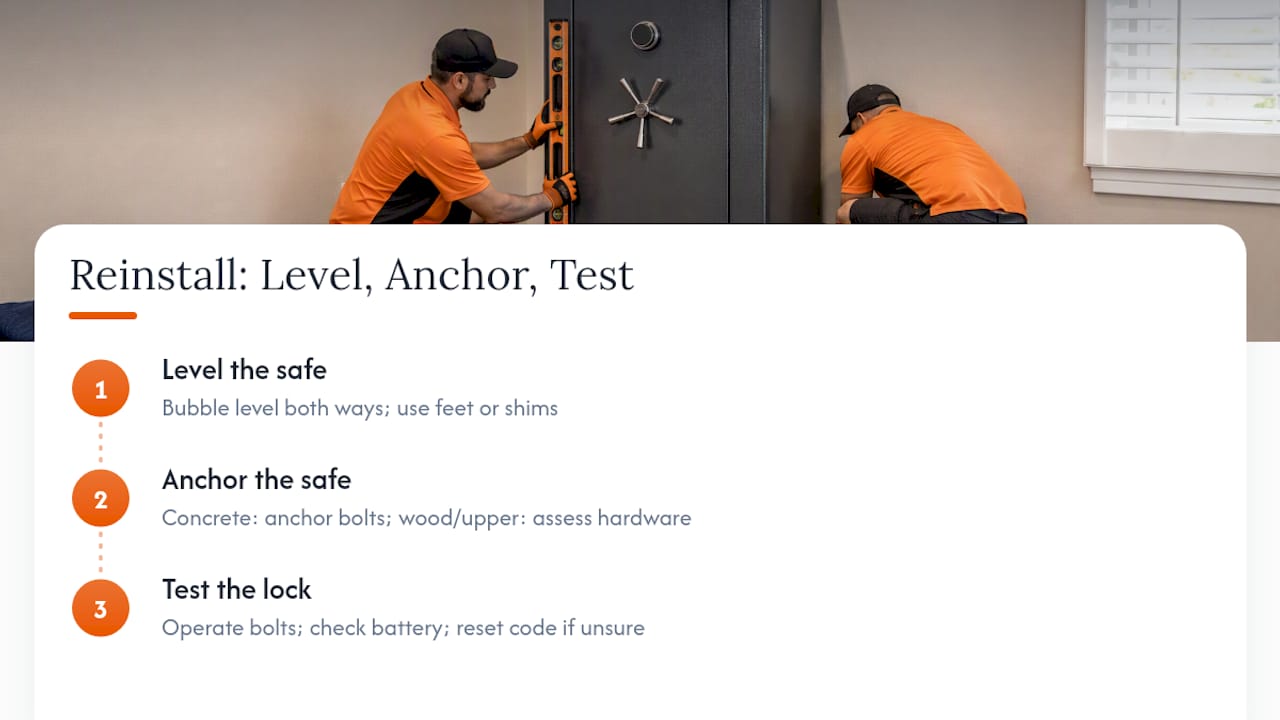
Start with leveling. Use a standard bubble level across the top of the safe in both directions. Even a slight lean stresses the door hinges over time and can cause the locking bolts to bind. Most safes have adjustable feet or leveling bolts at the base specifically for this; shims work as a backup if your model doesn't.
Once level, anchor the safe if the floor allows it. Concrete slab floors accept anchor bolts directly; safes on upper floors or over wood subfloors may need different hardware or a professional assessment of whether the floor can bear the anchored load safely. Anchoring matters most for theft deterrence and tip-over prevention, especially if children are in the home.
Finally, test the lock mechanism thoroughly before loading anything back inside. Open and close it several times, checking that the bolt work engages smoothly with no grinding or resistance. If your safe uses an electronic keypad, confirm the battery contacts weren't jostled during transport and reset the code if you have any doubt about tampering. Only after leveling, anchoring, and a clean lock test should you move firearms and valuables back in.
Orange Movers' Field Note
Orange Movers has moved gun safes throughout Fort Lauderdale and Broward County, and the pattern holds: floor protection and clear crew communication prevent more damage than raw muscle ever does.
— Orange Movers Team
How Orange Movers Handles Your Gun Safe Move
Orange Movers is the alternative to renting equipment and hoping for the best. For a safe move in Fort Lauderdale or anywhere across Broward, Miami-Dade, or Palm Beach County, our crews bring rated dollies, J-bars, and floor protection you'd otherwise have to source and install yourself, plus a lift-gate equipped truck sized for the load.

Before you request a quote, have a few details ready: the safe's exact dimensions and weight, whether stairs or tight turns are involved along the route, and your current flooring type at both the pickup and drop-off locations. That information lets us confirm crew size and equipment needs before your crew ever arrives. Our teams handle floor, wall, and doorway protection as standard practice on every heavy-item move, not as an upsell.
If your safe move is part of a larger relocation, browse our full range of moving services to see what else we can bundle into one straightforward, transparent quote.
Sources
- Can I move my safe? – Liberty Safe
- How to move a gun safe – U-Haul
- How to Move a Gun Safe Safely (and Why to Hire Pros) – MovingByDesign
- Gun Safe Movers - Moving Help®
FAQ
How much does it cost to move a gun safe?
Local moves typically run $295 to $357 for straightforward, flat-ground jobs, with stairs or added complexity pushing the total up by $100 to $200 or more, according to Moving Help.
What's the easiest way to move a gun safe?
The safest DIY approach uses a heavy-duty dolly rated at 1,200 pounds or more, a J-bar to position it, and at least three helpers moving on flat, protected flooring with no stairs involved.
How many people do you need to move a 600-pound safe?
A safe at 600 pounds exceeds the general 500-pound DIY threshold, so hiring professional movers with a rated stair-climbing dolly and an experienced crew is the recommended route rather than attempting it with additional helpers alone.
What kind of dolly do you need to move a gun safe?
Skip standard appliance dollies for anything beyond a lightweight safe; professional guidance recommends a heavy-duty safe dolly rated for 1,200 pounds or more, paired with a motorized stair climber if any steps are involved.