

To confirm you're hiring licensed and insured movers, ask for their USDOT/MC or state registration number and a certificate of insurance, then verify both directly in a government database. Never take a website's word for it. The federal cargo liability baseline of $0.60 per pound per article applies unless you request full-value protection, so knowing what you're covered for matters as much as knowing who's covered.
TL;DR:
- Verifying a mover's active federal and state registration numbers ensures they are legally authorized to operate and helps prevent fraud.
- Confirming the cargo liability coverage limits and requesting full-value protection can protect belongings worth more than the federal baseline of $0.60 per pound.
- Checking the mover’s insurance certificates and reviewing their history on FMCSA SAFER or state databases provides critical insight into reliability and safety.
- Recognizing red flags such as unusually low quotes, high deposits, or missing documentation can prevent working with unlicensed or uninsured crews.
- Orange Movers exemplifies best practices by offering active licensing, transparent pricing, and verifiable insurance documentation for all services.
Table of Contents
- Quick Verification Checklist: 5 Steps Before You Book
- How to Verify Federal Registration Through the FMCSA SAFER Lookup
- State and Local Licensing: What to Check for In-State Moves
- Insurance Types Movers Carry and What Each One Actually Covers
- What to Ask the Mover: Documents and Sample Questions
- Red Flags: Signs You're Dealing With an Unlicensed or Uninsured Crew
- How Orange Movers Documents Licensing and Insurance
- Why Verification Is the Cheapest Insurance You'll Buy
- Get a Verified Quote From a Licensed and Insured Team
- Where to Verify a Mover's License and Insurance
- Sources
Quick Verification Checklist: 5 Steps Before You Book
Run through these steps with every mover you're considering, before you hand over a deposit.
- Request registration numbers up front. Ask for the USDOT/MC number (interstate) or state registration number (intrastate) before discussing pricing.
- Verify the USDOT/MC number on FMCSA SAFER. For any move crossing state lines, this is your first stop.
- Check your state's household goods registry for local moves. Intrastate movers answer to state agencies, not FMCSA.
- Confirm cargo liability limits and ask about full-value protection. Know the baseline coverage before you need to file a claim.
- Treat hesitation as a red flag. A legitimate mover produces these documents in minutes, not days.
If any step stalls, pause the hiring process. You have time to find someone who answers faster.
How to Verify Federal Registration Through the FMCSA SAFER Lookup
Any mover crossing state lines needs an active USDOT number, and many also carry an MC number that establishes broker or carrier authority. These aren't the same thing. A broker arranges your move; a carrier physically transports your belongings. Knowing which one you're hiring matters when something goes wrong.
The FMCSA SAFER lookup takes about 90 seconds and shows you exactly what you need:
- Authority status. Confirm it reads "active," not "revoked" or "not authorized."
- Legal name match. The name in SAFER should match the name on your estimate, not a similar-sounding alias.
- Out-of-service and inspection history. This isn't a full safety audit, but a pattern of violations is worth noticing.
- Complaint history. Multiple recent complaints about a small operation is a signal worth weighing heavily.
Roughly 90 seconds is all it takes to catch a mismatch that would otherwise surface only after your furniture is already on the truck.
State and Local Licensing: What to Check for In-State Moves
Interstate authority through FMCSA doesn't cover moves that stay within one state. Intrastate movers register with state agencies instead, and every state runs this program differently.
California requires a Cal-T number issued through the Bureau of Household Goods and Services, along with a written estimate after a visual survey of your belongings. New York uses an MTR number issued through the Department of Transportation. Texas movers fall under guidance from the Texas DMV's consumer protection program, which walks through licensing basics and common scam patterns.
A few things to keep straight when checking credentials:
- Confirm both federal and state authority when your move might cross a state line partway through, even for a "local" relocation near a border.
- If you live in a high-rise or managed building, your HOA or building management likely requires a certificate of insurance naming the building as an additional insured before movers can access elevators or loading docks.
- State registration numbers and federal USDOT numbers are not interchangeable. A mover with one and not the other may only be authorized for one type of move.
Insurance Types Movers Carry and What Each One Actually Covers
A licensed mover typically carries several distinct policies, and each protects a different party in a different situation.
- General liability insurance covers property damage to your home, like a scratched wall or a dented doorframe during the move itself.
- Commercial auto insurance covers accidents involving the moving truck on the road.
- Workers' compensation covers the moving crew if someone gets hurt lifting your couch, which protects you from liability too.
- Cargo liability covers your belongings while they're in the truck, and this is the one most people misunderstand.
Federal rules set a baseline cargo liability commonly cited as $0.60 per pound per article. That means a 20-pound television is covered for $12 if it's damaged, regardless of what you paid for it. For anything valuable, antiques, electronics, art, ask about full-value protection, which reimburses closer to actual replacement cost for an added fee.
When you request a certificate of insurance, check the coverage limits listed on it, not just the policy names. A COI with a $10,000 general liability limit means something very different for a studio apartment than it does for a five-bedroom home.
What to Ask the Mover: Documents and Sample Questions
Request these four documents before you sign anything or pay a deposit:
- USDOT or MC number (interstate) or state registration number (intrastate).
- A certificate of insurance naming you, or your building, as the certificate holder.
- A written in-person estimate, based on an actual look at your belongings, not a phone guess.
- A sample of their standard bill of lading, which becomes your contract on move day.
When you talk to a sales rep, ask directly: "What's your cargo liability limit, and do you offer full-value protection?" Ask whether they use subcontractors, and if so, whether those subcontractors carry their own insurance or operate under the primary mover's policy. A vague answer here is worth pressing on.
Pro Tip: Save a screenshot of the SAFER results page and a PDF of the COI in the same folder as your moving contract. If a claim dispute comes up months later, having both documents dated and in hand saves you from a slow back-and-forth with a company that suddenly can't find your paperwork.
Red Flags: Signs You're Dealing With an Unlicensed or Uninsured Crew
Watch for these warning signs while comparing quotes:
- A quote dramatically lower than every other estimate you've received, with no clear explanation.
- Requests for large cash deposits with no written contract.
- A USDOT number that, when checked, belongs to a different company name than the one quoting you.
- Refusal or repeated delay in producing a certificate of insurance.
- Reviews or a website that appear copied nearly word for word from another moving company.
If you spot any of these, stop the process and verify the mover's registration directly rather than assuming the best. You can also report suspected fraud to FMCSA or your state's household goods agency. Keep deposits small, and never hand over full payment before the move is complete.
How Orange Movers Documents Licensing and Insurance
Orange Movers has served families and businesses across South Florida since 2010, operating out of Fort Lauderdale with a track record built on precision planning rather than guesswork. Here's what that looks like in practice.
- Local, long distance, and international moves are all handled under the same licensed and insured operation, so the paperwork you verify for a cross-town move is the same paperwork covering a move across the country.
- Every job includes furniture wrapping, floor protection, and debris removal as standard, not an upsell.
- Pricing is transparent with no hidden fees, and local knowledge of South Florida routes and buildings helps prevent day-of surprises.
- Clients can request a certificate of insurance naming themselves or their building as certificate holder, the same document this article recommends you verify for any mover.
That combination, active registration, real coverage, and documentation you can actually check, is what "licensed and insured" is supposed to mean.
Why Verification Is the Cheapest Insurance You'll Buy
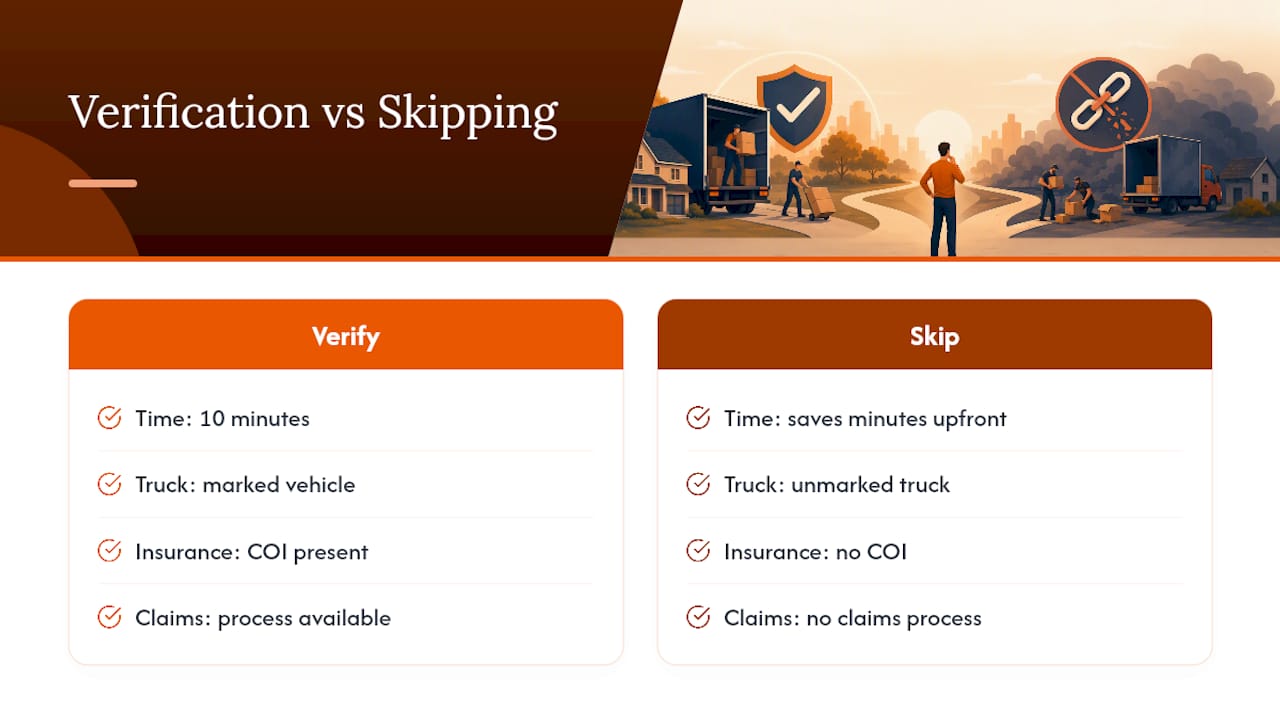
Spending ten minutes checking a USDOT number feels like overkill until you talk to someone who skipped it. The pattern is almost always the same: a lowball quote looked appealing, the crew showed up in an unmarked truck, and when a dresser got damaged, there was no COI, no claims process, and no one to call. That gap between "seemed fine on the phone" and "no recourse when something breaks" is exactly what registration checks and a certificate of insurance close.
Verification doesn't cost you anything but a little time, and it's the one step that determines whether a damaged item becomes a covered claim or a total loss. Run the checklist before you book, not after something goes wrong.
— Milo
Get a Verified Quote From a Licensed and Insured Team
Skipping the verification hassle starts with hiring a mover that hands you the paperwork before you ask twice. Orange Movers is fully licensed and insured, and every quote comes with a certificate of insurance you can check against your building's requirements or your own peace of mind, no chasing down documents after the fact.
Services cover local moving, long distance relocations, full-service packing, and commercial moves across Fort Lauderdale, Miami-Dade, Palm Beach County, and Boca Raton, all with transparent pricing and no hidden fees added after the fact. If you're relocating in the Miami area, you can see how the process works on the Miami movers page, or browse the full moving services overview to see what's included before you request pricing.
Ready to see numbers instead of guesses? Get a free, verified quote and ask for your certificate of insurance the same day you book.
Where to Verify a Mover's License and Insurance
- FMCSA SAFER lookup, for confirming USDOT/MC status on any interstate move.
- State household goods programs, such as California's BHGS, for intrastate registration checks.
- Moving, which requires network movers to maintain current registration and insurance before listing quotes.
Sources
- Search for a Registered Mover | FMCSA
- Guide to moving insurance | Extra Space Storage
- Moving
- Household Movers Information | BHGS (California)