
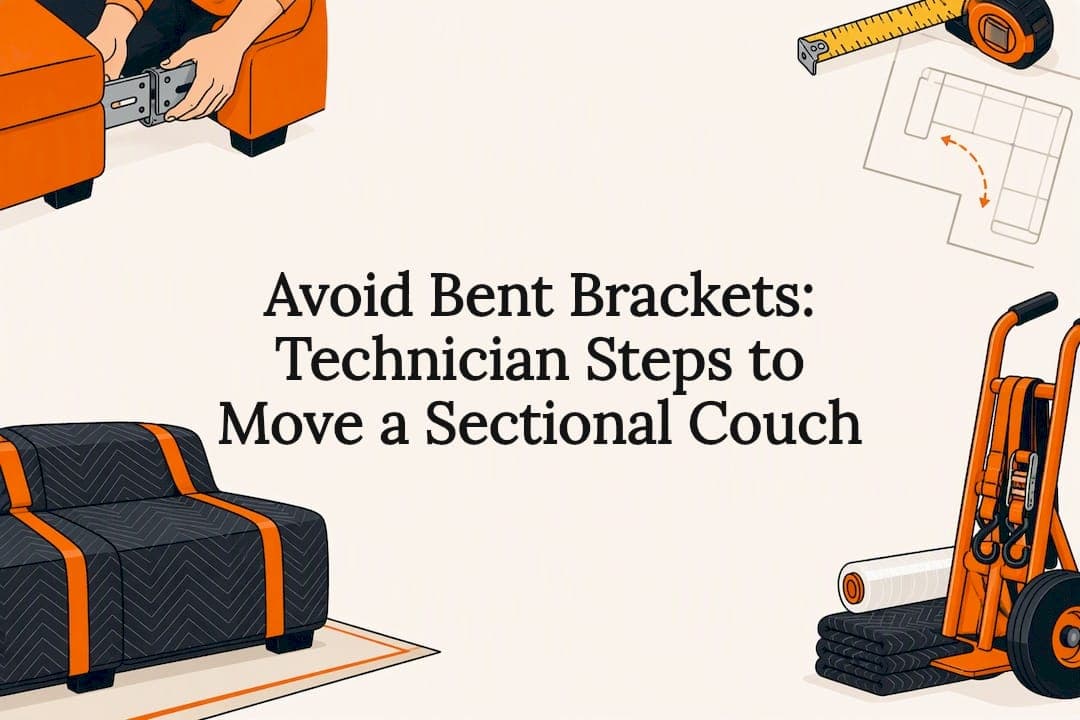
Yes, you can move a sectional couch yourself in most cases, but the smart first step is measuring your modules and doorways before you touch a screwdriver. Separate each section before you carry anything, since sectionals are built to be disconnected for exactly this reason. Reserve professional help for heavy modules, power reclining sections, or stairwells with tight turns. Whatever route you take, lift with your legs and protect every connector bracket along the way.
TL;DR:
- Measure each module's dimensions and diagonals carefully, then compare these measurements to doorway and stairwell openings for a safe fit.
- Identify your sectional's connector type before disassembly to avoid damaging brackets or hardware during removal.
- Use layered padding, stretch wrap, and separate hardware bags to protect modules and facilitate reassembly afterward.
- Employ appropriate tools such as furniture dollies and ratchet straps, and push rather than pull to reduce physical strain during transportation.
- For complex or tight spaces, professional help is recommended to prevent damage and ensure safe, efficient moving.
Table of Contents
- How to measure each module and map the moving route
- Step-by-step: identify connector type and disconnect safely
- How to wrap and protect each module and fragile trim
- Which tools to use and how to lift safely
- Angles and tricks to get sectional modules through tight doorways, stairwells, and corners
- Best practice for packing sectionals into a truck and securing them for transit
- How to reassemble and check the sectional at the destination
- Orange Movers' real-world sectional-moving workflow and when to hire us
- What the "move it yourself" advice usually gets wrong
- Get help moving your sectional without the guesswork
- Primary manuals and safety guides to consult
- Sources
- FAQ
How to measure each module and map the moving route
Every sectional move starts on a tape measure, not a moving dolly. Before you disconnect anything, measure each module's width, height, and depth, then take a diagonal measurement corner to corner. That diagonal number matters more than most people realize: it tells you the largest opening a module can pass through when you tilt it, which is often the difference between a clean move and a stuck couch in a hallway.
Compare those numbers against every doorway, hallway, and stairwell landing the piece has to travel through. Trim, baseboards, and handrails all steal usable inches, so measure the actual clear opening, not the rough frame width. Manufacturer guidance and delivery teams recommend leaving at least 2 to 3 feet of clearance around a sectional before you start disconnecting modules, which gives you room to angle pieces without scraping walls or trim.
Write everything down. A simple chart with each module's dimensions, plus a phone photo of tight spots like stairwell turns or narrow entry doors, saves real time on moving day.
- Measure width, height, depth, and diagonal for each module before disconnecting anything.
- Check doorway and hallway clearances against the diagonal measurement, not just the straight width.
- Photograph tight turns, low handrails, or trim that could catch fabric or wood edges.
- Clear rugs, floor mats, and loose cords from the path so nothing shifts under a mover's feet.
- Remove doorstops or a door from its hinges in advance if a module barely clears the frame.
Doing this groundwork first turns moving day into a routine rather than a series of surprises.
Step-by-step: identify connector type and disconnect safely
Sectionals stay together through one of three common connector styles, and knowing which one you have changes how you approach the disconnect.
- Check for side-mount brackets. These sit flush against the outer frame of each module and usually take a bolt or screw you can reach from the side; loosen and remove the fastener fully before pulling modules apart.
- Look underneath for pivoting locks. Some sectionals use an under-mount bracket that rotates or slides to release, so flip the module slightly or reach underneath to find a lever or turn-latch rather than forcing modules apart horizontally.
- Check for alligator clips. These spring-loaded metal clips grip both modules from underneath and typically release when you squeeze or pry them open with a flathead screwdriver.
- Lift at the bracket, not the cushions. Once a connector is released, lift each module slightly at the joint to separate it fully instead of dragging it sideways, which can bend brackets or tear fabric near the seam.
- Bag and label every screw, bolt, and leg. Use a separate zip-top bag for each module's hardware and label it with painter's tape (Module A legs, Module B bracket bolts) so reassembly is not a guessing game later.
Manufacturer instructions, including the La-Z-Boy sectional assembly manual, are direct on one point: connecting brackets join modules together for everyday use, but they are not built to bear the weight or torque of moving. Moving a sectional while it is still connected puts stress directly on those brackets and is one of the most common ways owners crack or bend them. Disconnect first, every time, even for a short move across the room. If you run into a connector that will not budge or looks different from anything described above, stop and photograph it rather than forcing it. Orange Movers' furniture disassembly and reassembly service exists partly for exactly these unusual hardware situations.
How to wrap and protect each module and fragile trim
Once modules are apart, protection is what keeps fabric, foam, and wood trim intact through the rest of the move. A layered approach works best: start with a moving blanket over the entire module, follow with stretch wrap to hold the blanket in place, and finish with a waterproof layer if the piece will spend any time outdoors or in an open truck.
Never tape directly onto fabric upholstery. Adhesive residue and the pulling motion of tape removal can both damage or discolor fabric, sometimes permanently. Stretch wrap does the same securing job without touching the couch material itself.
- Wrap each module fully in a moving blanket, then secure it with stretch wrap rather than tape.
- Pad exposed wooden legs, feet, and any protruding hardware with bubble wrap or folded cardboard.
- Cover connector brackets with cardboard corners to prevent them from snagging on doorframes or other furniture.
- Bag cushions and pillows separately in plastic sleeves so they stay clean and are not crushed under other items.
- Keep hardware bags taped to the inside of a nearby box, never loose in the truck, so nothing gets lost in transit.
Pro Tip: Wrap fragile decorative trim, like nailhead accents or wood inlay, in bubble wrap before the blanket layer goes on, since a single moving blanket alone will not stop sharp edges from denting during a bump.
For anyone assembling supplies at home, Orange Movers' moving blankets, stretch wrap, and boxes are sized for full sofa modules, which saves a trip to guess at quantities.
Which tools to use and how to lift safely
Choosing the right equipment matters as much as choosing the right technique. A flat furniture dolly works well for sliding a wrapped module across level flooring, while an appliance dolly with straps is a better fit for narrow modules that need to stay upright through a doorway. Furniture sliders under the legs help for short indoor distances where a dolly would be overkill.
For securing a module to a dolly or handcart, use rated ratchet straps rather than bungee cords. Bungee cords stretch unpredictably under load and can snap or release suddenly, while a ratchet strap holds a fixed, adjustable tension.
Ergonomics guidance from Duke University's safety office recommends pushing loaded equipment rather than pulling it whenever the path allows, since pushing keeps your body weight working with the load instead of straining your lower back. The same guidance calls for lifting with your legs, keeping the load close to your body, and using mechanical aids like dollies specifically to reduce the physical force your body absorbs.
A properly loaded dolly reduces the physical strain of moving heavy furniture by letting the wheels and frame carry the weight instead of your back and arms, according to Duke's guidance on wheeled equipment.
- Choose a flat dolly for sliding wrapped modules across flat, open floors.
- Use an appliance dolly with a strap for modules that need to stay upright through doorways.
- Skip bungee cords entirely in favor of rated ratchet straps for anything on wheels.
- Wear closed-toe shoes and gloves, and keep a second person nearby for anything over a comfortable one-person lift.
Yale's guidance on wheeled equipment adds that a stack or load needs to be balanced and secured before you start pushing, since an unbalanced dolly load is a common cause of tipping accidents.
Angles and tricks to get sectional modules through tight doorways, stairwells, and corners
Tight spaces are where most sectional damage happens, and where most DIY movers waste the most time. A few deliberate techniques make the difference between a smooth pass and a stuck couch.
- Use the diagonal measurement, not the straight width. Tilting a module at an angle and walking it through on its diagonal axis often clears a doorway that looks too narrow when the couch is upright.
- Try the high-low carry. One person lifts the top of the module while the other holds the bottom low and slightly forward; this staggered angle lets the piece clear low ceilings, stair rails, or an awkward turn that a flat carry cannot.
- Pivot with the "smile" technique on stairwells. Rotate the leading edge of the module in a slight arc, like tracing a smile, as it clears each landing, rather than forcing it straight through a turn.
- Remove doors or doorstops in advance. Pulling hinge pins on an interior door can add 2 to 4 inches of clearance, which is often exactly the gap a snug module needs.
- Assign clear roles on stairs. The person below controls the weight and sets the pace, while the person above guides direction and calls out turns, since most stairwell accidents happen when both movers try to lead at once.
If a module will not clear a stairwell or doorway even at its diagonal, stop rather than forcing it. Balcony lifts, window removals, or extremely tight multi-story stairwells may require professional rigging and experience to avoid damage.
Best practice for packing sectionals into a truck and securing them for transit

Loading logic matters as much as wrapping logic. The wall method, placing large flat pieces like sofa backs against the truck's side walls in a vertical position, saves floor space and keeps upholstery away from shifting boxes. Heavier, denser items go toward the front of the truck near the cab, since that's where weight distribution keeps the vehicle stable on the road.
Secure each module with two straps at different heights: one low, near the base, to stop the piece from sliding, and one roughly two-thirds up the module to resist tipping or pivoting. An X-pattern across two straps adds lateral stability for tall or awkward pieces. Load bars placed between tiers keep stacked items from crushing a sectional module underneath.
- Load heavier modules and dense boxes toward the front of the truck, closer to the cab.
- Place sofa backs vertically against a wall using the wall method to save floor space.
- Strap each module at two heights, low and about two-thirds up, in an X-pattern where possible.
- Fill remaining gaps with soft goods like blankets or pillows so nothing has room to shift.
- Recheck every strap after the first 15 to 20 minutes of driving, since loads commonly settle once the truck is moving.
Pro Tip: If a sectional has a power recliner or motorized feature, unplug and secure the wiring before loading it, since a wire caught under a strap or shifting box is one of the more common causes of motor damage during transport.
How to reassemble and check the sectional at the destination
Reassembly goes fastest when you reverse your disassembly steps in order and rely on the labeled hardware bags and photos you took beforehand. Match each bag to its module label, reconnect brackets in the same sequence you removed them, and confirm every bolt or clip is fully seated before setting the sectional in place.
If your sectional has a reclining or powered section, test it before you consider the job finished. Reconnect any power cord, then check that the mechanism moves smoothly without unusual resistance or sound.
- Reconnect modules in reverse order of disassembly, using your labeled hardware bags.
- Test reclining or motorized features immediately to catch any transport damage early.
- Inspect fabric seams, wood trim, and connector brackets for scuffs, tears, or bent hardware.
- Vacuum or wipe down each module before final placement, since packing materials can leave dust or residue.
Orange Movers' real-world sectional-moving workflow and when to hire us
Orange Movers crews approach every sectional the same way: measure each module and the full route first, identify the connector type, then disassemble before anything is lifted. Modules get quilt-wrapped in moving blankets and secured with stretch wrap, and any exposed brackets or legs are padded separately to prevent snags during loading. You can see the quilt-wrapping and furniture padding methods we rely on for upholstered pieces on nearly every job.
Certain scenarios call for professional handling rather than a DIY attempt: tight stairwells with multiple turns, power reclining sectionals with wiring to protect, and balcony or window lifts that require rigging. Incorrect handling in these cases can cause damage to the piece or the building.
If you would rather book the work outright, Orange Movers offers single-item and heavy piece transport for sectionals moving on their own, along with on-site estimates and hourly labor-only assistance for movers who just need extra hands for a few hours.
What the "move it yourself" advice usually gets wrong
Most DIY sectional guides treat disassembly as the hard part and lifting as an afterthought. In practice, it's the reverse. Disconnecting a bracket takes five minutes once you know which type you have. The physical toll of carrying an unbalanced 200-pound module through a stairwell turn, repeatedly, is where backs get hurt and walls get dented.

The other overrated piece of advice is treating every sectional the same way. A three-module fabric sectional with simple side-mount brackets is a reasonable weekend DIY project for two capable people. A power reclining sectional with a motor, wiring, and pivoting under-mount locks is a different job entirely, and forcing it through the same generic checklist is how wiring gets pinched or a motor gets cracked.
If there's one thing worth prioritizing above all the wrapping and strapping advice, it's this: match your plan to the actual piece in front of you, not to a generic couch. Measure honestly, identify your connector type before you touch a tool, and be willing to call in help the moment a module fights you at a turn it clearly should not fight.
— Orange Movers Team
Get help moving your sectional without the guesswork
Moving a sectional yourself works fine for many households, but there's no penalty for skipping the sore back and the risk of a cracked bracket. Professional movers often handle sectional disassembly, quilt-wrapping, and reassembly as a routine part of moves to help ensure the piece arrives in the same condition it left in.

Booking gets you a free on-site estimate, a fully insured crew, and the same protection techniques described throughout this guide, applied by people who do it daily. If you only need extra hands for a couple of hours rather than a full move, our hourly labor-only assistance covers exactly that. For a sectional moving as a single item, start with a quote for single-item and heavy piece transport and get a clear plan before moving day arrives.
Primary manuals and safety guides to consult
The La-Z-Boy sectional manual confirms how connector brackets work and why they should not bear moving loads. Duke's ergonomics bulletin and Yale's equipment guidance cover safe lifting and wheeled-aid practices in more detail. For hanging mirrors or wall art safely once you've settled into a new place, GothMarket's guide to heavy mirrors is a useful next read.
Sources
- La‑Z‑Boy sectional assembly/disassembly manual
- Duke University safety bulletin on pushing, pulling and moving equipment
- Yale EHS guidance on moving heavy loads and using wheeled equipment
- How to move a couch — The Home Depot
FAQ
Can I move a sectional couch by myself?
Yes, for many sectionals a healthy adult or two can manage the move alone, provided you disconnect the modules first and use a dolly or straps rather than carrying pieces by hand. Heavier modules, power reclining sections, or tight stairwells are better handled with a second person or professional help, since the physical strain and damage risk both increase sharply.
What is the 2/3 rule for sofas?
There is no single standardized "2/3 rule" in manufacturer or safety guidance; the phrase is sometimes used informally to describe placing one securing strap roughly two-thirds up a module's height to resist tipping, paired with a lower strap to stop sliding. This two-height strapping approach is a recognized practice for securing furniture in a moving truck.
Is there a sectional couch I can rearrange easily?
Many modern sectionals are designed with modular connector brackets specifically so owners can rearrange or reconfigure the layout without special tools, though the exact process depends on the connector type your model uses. Checking your manufacturer's assembly manual is the most reliable way to confirm how your specific sectional reconfigures.
Can one person move a couch with a dolly?
A single person can move a lighter, disconnected sectional module with a flat dolly or furniture sliders on level ground, but a full unbroken sofa or a heavier module is safer with two people. Pushing a dolly rather than pulling it, as ergonomics guidance recommends, reduces strain regardless of how many people are helping.
Should I hire professionals to move a sectional couch?
Hiring professionals makes sense for power reclining sectionals, tight stairwells, balcony or window lifts, and any situation where a connector type is unfamiliar or hard to reach. Professional movers generally provide on-site estimates and specialized transport for heavier or more complex sectional moves.