
Three real coverage routes exist when you move: your mover's default released value protection, an upgraded full-value protection plan, and a separate third-party moving insurance policy. For most long-distance moves, full-value protection is worth the extra cost, and a small third-party policy fills the gaps it leaves, especially for boxes you packed yourself. Before moving day, ask your mover for a written full-value rate and call your insurer to confirm what your homeowners or renters policy actually covers in transit.
TL;DR:
- Full-value protection is recommended for long-distance moves, with costs typically under 1% of declared value, and offers repair, replacement, or cash payout.
- Third-party insurance covers packed-by-owner boxes and high-value items better than carrier liability, costing around 1.25% to 2% of declared value.
- Renters or homeowners policies often do not cover damages caused during moving, making specific transit coverage or third-party policies necessary.
- Obtaining written rates for full-value protection and clearly understanding deductibles and coverage limits helps prevent disputes during claims.
- Filing claims promptly and documenting belongings thoroughly is essential, with federal law allowing up to nine months to report damages after an interstate move.
Table of Contents
- What Are Your Moving Insurance Options: RVP vs. FVP
- Third-Party Moving Insurance: What It Covers That Carrier Valuation Doesn't
- Does Renters or Homeowners Insurance Cover a Move?
- What Does Moving Insurance Cost? A Quick Estimate
- How to Choose the Right Moving Insurance Coverage
- Filing a Moving Insurance Claim: Timelines and Documentation
- How Orange Movers Protects Your Belongings and Supports Your Coverage Decisions
- Coverage by Move Type: A Fast Reference
- Get Help Choosing Coverage for Your South Florida Move
- Sources
- FAQ
What Are Your Moving Insurance Options: RVP vs. FVP
Every interstate mover in the United States has to offer two valuation choices, and understanding the gap between them is the whole ballgame. Released Value Protection (RVP) is the free, default option: if a mover damages or loses something, you get $0.60 per pound per article, regardless of what it actually cost. A 4-pound laptop worth $1,200 nets you $2.40. That math is why RVP alone leaves most households badly underinsured.
Full Value Protection (FVP) works differently. You declare the total value of your shipment, and if something is damaged, the mover repairs it, replaces it, or pays cash, at their choice, based on current market value rather than weight. FVP typically comes with a deductible option, and rates scale with your declared value.
Pro Tip: Never accept RVP as a "free upgrade later" plan. Movers price FVP at booking, and switching after loading day is rarely possible.
| Coverage | Cost to You | Pay out Basis | Regulator |
|---|---|---|---|
| Released Value Protection | Free (default) | $0.60/lb per article | FMCSA (interstate) |
| Full Value Protection | Mover's declared rate | Repair, replace, or cash at market value | FMCSA (interstate) |
| Third-party moving insurance | Separate premium | Policy terms, often all-risk | State insurance department |
Intrastate movers follow state rules that can differ, so confirm valuation requirements with your mover if your move stays inside one state.
Third-Party Moving Insurance: What It Covers That Carrier Valuation Doesn't
Third-party moving insurance is a genuine insurance policy, sold by a state-licensed insurer, not a carrier liability program. That distinction matters practically: FVP and RVP are liability limits set by the mover, while a third-party policy gives you contractual rights you can pursue through your state insurance department if a claim gets denied unfairly.
The biggest practical advantage is packed-by-owner (PBO) coverage. Carrier valuation programs typically exclude or sharply limit PBO boxes unless there's visible exterior damage. A third-party policy, when boxes are itemized on your inventory, will usually cover the contents anyway.
Third-party premiums commonly run 1.25% to 2% of declared value, often with a deductible, according to industry moving insurance comparisons. That's a modest add-on next to the replacement cost of even one damaged dining set or antique dresser.
Consider third-party coverage when you have:
- A large number of self-packed boxes
- Fine art, collectibles, or family heirlooms with no easy replacement value
- Extended storage-in-transit before delivery
- A move scheduled during hurricane season in South Florida, when weather delays are more likely
Pro Tip: Ask whether the policy is "named-peril" (covers a specific list of causes) or "all-risk" (covers everything except stated exclusions). All-risk policies cost more but close far more gaps.
Does Renters or Homeowners Insurance Cover a Move?
Renters and homeowners insurance can cover some of your belongings while they're off-premises, but the coverage is narrower than most people assume. These policies generally protect against named perils, fire and theft being the two most common, while your things sit in a truck or warehouse. What they typically will not cover is mover-caused damage: a scratched dresser, a cracked mirror, a dropped television. Liberty Mutual's guidance on moving coverage makes this distinction clear, and it's the single most common source of claim disappointment.
Here's how to use your existing policy well instead of assuming it will bail you out:
- Call your insurer before moving day and ask specifically about off-premises and in-transit coverage.
- Get the answer in writing or note the date, time, and representative's name.
- Ask about sub-limits on categories like jewelry or electronics, which are often capped far below their real value.
- If gaps show up, ask about a short-term rider or endorsement to raise limits just for the move window.
The Insurance Information Institute recommends comparing your homeowners or renters coverage against your mover's valuation options before deciding what, if anything, to add.
Pro Tip: Take timestamped photos of high-value items right before the crew arrives. If a claim ever comes down to "before and after," your phone's photo timestamps are your best evidence.

What Does Moving Insurance Cost? A Quick Estimate
Pricing moving insurance options isn't complicated once you have a declared value in mind. Full-value protection generally runs around 1% of your declared shipment value, though the range stretches from roughly 0.5% to 3% depending on the deductible you pick, according to industry pricing comparisons. Third-party policies land a bit higher, typically around one to two percent, since they cover more scenarios, including PBO boxes.
Here's a rough worked example for a household declaring $50,000 in belongings:
- FVP at around one percent: about $500, before any deductible discount
- Third-party rider at around one and a half percent: about $750 for broader, all-risk style coverage
- Combined stack: often under $1,000 total for meaningful protection on a $50,000 shipment
Choosing a higher deductible lowers your premium but raises your out-of-pocket cost per claim, and adding PBO coverage to a third-party policy usually adds a modest amount to the base rate.
How to Choose the Right Moving Insurance Coverage
Comparing quotes gets a lot easier once you know exactly what to ask. Walk through this checklist with any mover or insurer before you sign anything:
- Declared shipment value. What number are you insuring, and does it match your actual replacement cost estimate?
- Pair-and-set rules. If one item in a matched set is damaged, does the policy pay for the whole set or just the damaged piece?
- PBO coverage. Will the policy cover boxes you packed yourself if they're itemized on the inventory?
- Storage-in-transit duration. How many days of storage are covered before rates or terms change?
- Deductible options. What choices are available, and how does each change the premium?
- Written tariff rate. Can you get the FVP rate per $1,000 of declared value in writing?
A good script to use on the phone: "What is your full-value protection rate per $1,000 of declared value? What deductibles are available? Do you cover packed-by-owner boxes if they're itemized?"
Watch for red flags, too: a mover who won't put a tariff rate in writing, a claims window noticeably shorter than what federal guidance allows, or vague language about "replacement value" with no specifics.
Pro Tip: Get every valuation rate and deductible in writing before loading day. Verbal promises don't hold up in a claim dispute.
Filing a Moving Insurance Claim: Timelines and Documentation
Documentation wins claims, and timing loses them if you're slow. Before your move, gather photos of high-value items, a signed copy of your household inventory, the bill of lading, receipts for anything expensive, and a separate list of what's inside your PBO boxes.
Federal rules give you up to nine months to file a claim on an interstate move, but that's the outer limit, not a safe target. Many movers write much shorter internal deadlines into their contracts, sometimes 30 to 60 days, and missing that window can forfeit your remedy even though federal law would still allow more time.
File as soon as damage is discovered. If your mover's response feels inadequate, you can escalate to your state insurance commissioner (for third-party policies) or FMCSA (for interstate carrier disputes).
How Orange Movers Protects Your Belongings and Supports Your Coverage Decisions
Good insurance is a backup. Good handling is the first line of defense, and it's where Orange Movers puts most of its attention. Every crew wraps furniture in furniture padding, shrink-wrap, and quilt-wrapping before it ever leaves your home, and our team builds a documented inventory as items are loaded, the same paperwork that makes a claim easier if you ever need one.
When customers ask about coverage, we walk through the difference between released value and full-value protection honestly, help you settle on a declared value that reflects what you actually own, and point you toward third-party coverage when a shipment includes fine art, antiques, or a heavy volume of self-packed boxes. You can see examples of our protective packing methods in our moving gallery.
If your move includes anything unusually fragile or valuable, ask us about fragile-only custom packing before your moving date, not the morning of.
Coverage by Move Type: A Fast Reference
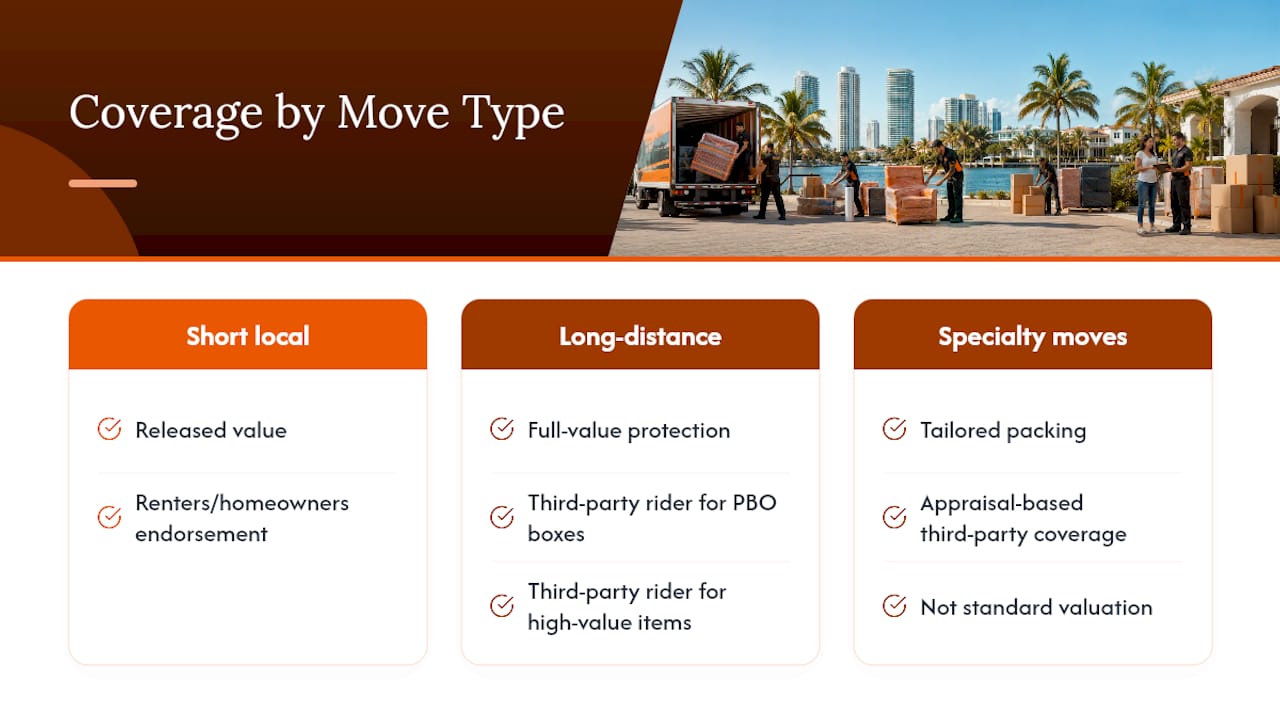
Short local moves with modest-value belongings often do fine with released value plus a renters or homeowners endorsement. Long-distance and interstate moves justify full-value protection, plus a small third-party rider for PBO boxes or high-value items. Pianos, fine art, and similar specialty pieces usually need tailored packing and appraisal-based third-party coverage, not standard valuation.
Get Help Choosing Coverage for Your South Florida Move
Picking between released value, full-value protection, and a third-party policy is easier when the crew moving your belongings is the same one helping you document their value. Orange Movers works with families and businesses across Fort Lauderdale, Broward County, Miami-Dade County, and Palm Beach County, and every job starts with the same careful approach: protective wrapping, an organized loading plan, and a documented inventory that supports whatever valuation choice you make.

Whether you're planning a local move across Fort Lauderdale or a long-distance relocation out of state, our crews handle full-service packing and unpacking, fragile-item protection, and storage for items that need to sit between moves. We talk through valuation options with every customer before moving day, not after something goes wrong, so you're not guessing at coverage terms while boxes are already on the truck.
Ready to plan your move with a crew that documents what it loads? Request a free quote and ask us directly about full-value protection rates and packing options for your household.
Sources
- How do I insure my belongings during a move? | FMCSA
- Moving Insurance Types Compared 2026: Released Value vs Full Value vs Third-Party | Moving Calculator
- Does renters insurance cover my belongings while moving? | Liberty Mutual
FAQ
Is It Worth Buying Moving Insurance?
For most households, yes, especially on long-distance moves where released value protection's $0.60-per-pound payout falls far short of real replacement costs. Full-value protection plus a small third-party rider for self-packed boxes typically costs under $1,000 on a $50,000 shipment, which is inexpensive compared to replacing even one major piece of furniture.
What Insurance Do You Need When You Move Out?
You need to decide between your mover's released value protection (free but minimal) and full-value protection (paid, but pays real market value). Many households also add a third-party policy for packed-by-owner boxes and high-value items, and it's worth calling your renters or homeowners insurer to confirm what off-premises coverage you already have.
What Kind of Insurance Should Movers Have?
Any licensed interstate mover must offer both released value and full-value protection under FMCSA rules, and the mover itself should carry commercial liability and cargo insurance. The company operates with licensed, insured crews and discusses valuation options with every customer before the move begins.
How Does Insurance Work When Moving?
You select a valuation level with your mover, released value or full-value protection, before loading day, and that choice determines how much you'd be paid for damaged or lost items. If you want broader coverage, especially for self-packed boxes or irreplaceable items, a separate third-party policy from a state-licensed insurer fills the gaps carrier valuation leaves behind.