
Expect to pay somewhere between $5,000 and $15,000 for a typical office move, with small offices landing near $750 and large or complex relocations climbing past $30,000. Three factors decide where you fall in that range: office size and headcount, distance and building access, and how much specialized IT or furniture handling the job requires. Start comparing office moving costs by booking a walkthrough quote before you commit to a moving date.
TL;DR:
- Larger or more complex moves will significantly increase costs due to IT handling, specialty equipment, and building access constraints like elevators or loading docks.
- Moving offices with high desk density or across long distances can double or triple the expected labor and transportation expenses based on the size and location.
- Precise quotes depend on thorough inventories, site walkthroughs, and upfront documentation of access restrictions to avoid surprise charges or delays.
- Budget overruns often stem from indirect costs such as downtime, IT reconfiguration, lease exit fees, and temporary storage, which should be factored into the initial planning.
- Scheduling a move during mid-week, planning phased relocations, and decluttering beforehand can reduce overall expenses and minimize business disruption.
Table of Contents
- What Drives Office Moving Cost the Most?
- How Much Does It Cost to Move a Small, Medium, or Large Office?
- What Line Items Show Up on an Office Moving Invoice?
- How Do You Get an Accurate Office Moving Quote?
- What Hidden Costs Do Businesses Forget to Budget For?
- When Should You Schedule an Office Move to Save Money?
- Who Handles Commercial Moves in South Florida?
- Why Most Office Moving Budgets Fail Before the First Box Ships
- Ready for a Straightforward Office Moving Quote?
- Sources
- FAQ
What Drives Office Moving Cost the Most?
Two offices with the same square footage can get wildly different quotes, and the reason almost always comes down to labor hours, building access, and equipment complexity rather than distance alone.
Square footage, headcount, and density. More desks mean more boxes, more furniture to disassemble, and more truck capacity. A crowded 3,000 square foot office with 40 employees typically takes longer to pack and load than a sparse 5,000 square foot space with 15 people, because density drives labor hours more directly than raw square footage does.
Distance and pricing models. Local moves within Broward County, Miami-Dade County, and Palm Beach County are usually billed hourly, based on crew size and truck count. Long-distance or interstate moves shift to weight-and-mileage pricing, which changes how you should budget entirely. If your relocation crosses state lines, long-distance moving pricing structures work very differently from a same-county move.
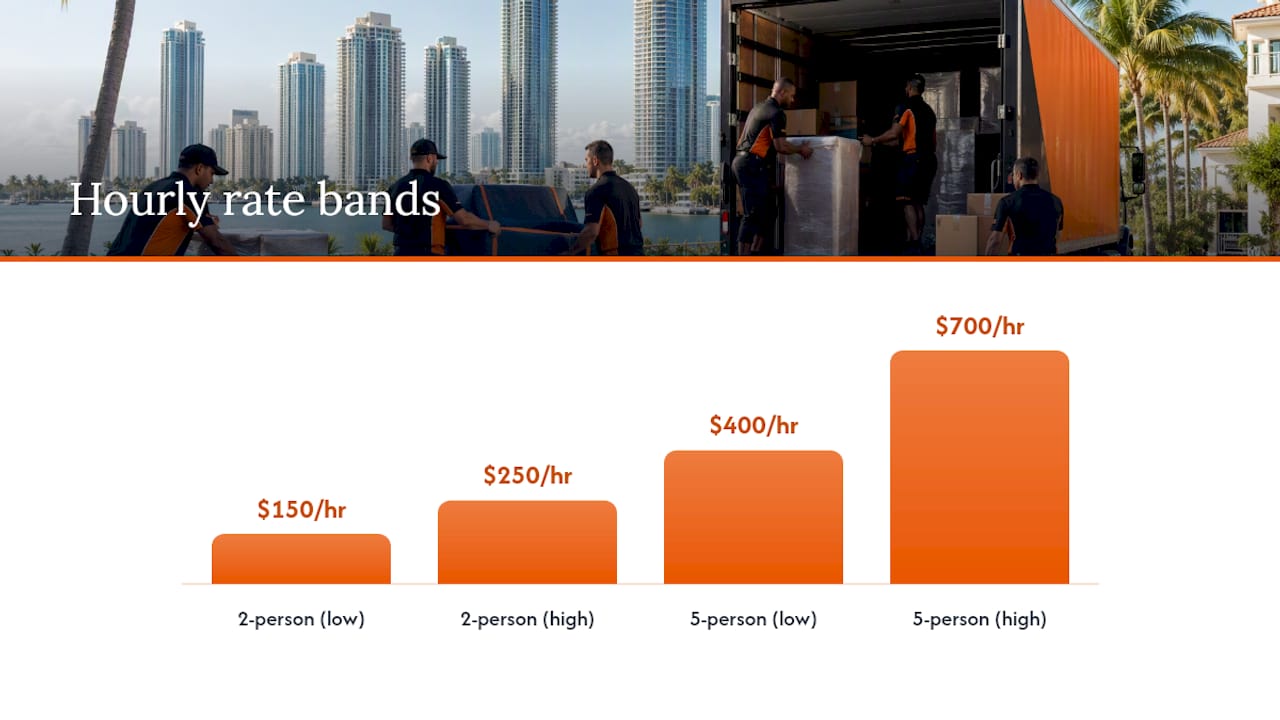
Hourly crew-size pricing bands. A two-person crew with one truck might run $150 to $250 an hour; a five-person crew with two trucks for a larger office can run $400 to $700 an hour. The math adds up fast, which is why accurate hour estimates matter more than the hourly rate itself.
IT and specialty equipment. Server racks, multi-line phone systems, and networking gear need careful disconnection, labeling, and reconnection. A 30-person office can spend $5,000 to $10,000 or more on IT relocation alone, depending on how much cabling and equipment reconfiguration is involved.
Building access constraints. Elevator reservations, long stair carries, and restrictive parking or loading dock rules are frequently the single biggest driver of price variation between two similarly sized moves. Downtown high-rises with strict freight elevator windows often add hours that a ground-floor suburban office never needs.
- Higher desk density adds labor hours, not just box count
- Interstate moves price by weight and mileage, not by the hour
- Crew size and truck count set your hourly rate band
- Server and phone system handling can be a five-figure line item on its own
- Elevator scheduling and loading dock access can add unplanned hours fast
Pro Tip: Ask your building manager for freight elevator reservation windows before your moving company builds the quote. A two-hour elevator slot that should take four hours because of shared building traffic is one of the most common causes of surprise overtime charges.
How Much Does It Cost to Move a Small, Medium, or Large Office?
Matching your office to a size category gives you a fast first-pass budget before you request formal quotes.
Small offices (1 to 10 desks) typically run $750 to $2,500 for a local move. Costs climb toward the high end when there's a lot of furniture disassembly, a second-floor walkup with no elevator, or a tight moving window that requires weekend labor.
Medium offices (11 to 50 desks) usually fall between $3,000 and $10,000. IT complexity is the biggest swing factor here: a business running its own server room and VoIP phone system will pay meaningfully more than one operating entirely on cloud-based software with laptops.
Large offices (50+ desks) often range from $10,000 to $30,000 or beyond, especially when the move happens in phases across multiple floors or buildings to avoid shutting down operations entirely. Specialized handling for conference room AV equipment, file storage systems, and break room appliances adds to the total.
- Small office (1 to 10 desks): $750 to $2,500 local
- Medium office (11 to 50 desks): $3,000 to $10,000 local
- Large office (50+ desks): $10,000 to $30,000+, often phased
- Local move (under 100 miles): priced hourly by crew and truck count
- Regional or cross-country move: priced by weight, distance, and services added
Distance changes these numbers directly. A local move across Fort Lauderdale might land at the low end of its size bracket, while the same office relocating from Fort Lauderdale to Orlando or out of state adds transportation charges on top of the base labor cost. A rough rule of thumb: budget one desk per $150 to $300 in moving labor for a local move, then add IT and specialty handling separately.
What Line Items Show Up on an Office Moving Invoice?
An itemized quote should break your total into distinct categories so you can compare bids apples to apples instead of guessing what's bundled into a single number.
| Line Item | Low | Average | High | Notes |
|---|---|---|---|---|
| Packing labor & materials | $300 | $800 | $2,000 | Higher with fragile electronics or full-service packing |
| Moving labor & crew | $750 | $3,500 | $15,000 | Scales with desk count and hours worked |
| Truck & fuel | $150 | $500 | $2,000 | Rises sharply for long-distance moves |
| IT/server disconnect & setup | $500 | $5,000 | $10,000 | Depends on server room size and cabling complexity |
| Temporary storage | $100 | $400/mo | $1,200/mo | Needed when new space isn't ready on moving day |
| Insurance/valuation coverage | $0 | $150 | $600 | Basic coverage often included; full-value costs extra |
| Permits & building fees | $0 | $200 | $800 | Common in downtown high-rises with strict loading rules |
Most office relocation budgets list these as separate categories rather than one lump sum, and complexity triggers like stair carries or oversized furniture typically get billed as add-ons rather than folded into the base labor rate.
How Do You Get an Accurate Office Moving Quote?
A written estimate is only as good as the information the moving company had when they built it. Skipping the walkthrough is the fastest way to end up with a quote that doesn't match your final bill.
- Schedule an in-person or virtual walkthrough. Have the estimator see or view every room, including storage closets and any areas with stairs, so nothing gets missed.
- Build a full inventory checklist. List desks, chairs, filing cabinets, servers, specialty equipment, and anything going into storage rather than the new space.
- Ask about surcharges directly. Get clear answers on elevator fees, stair carry charges, long-carry distances from the truck to the door, and weekend or after-hours rates.
- Request proof of insurance. Ask for a certificate of insurance (COI) if your building management requires one, and confirm what valuation coverage is included versus optional.
- Clarify the pricing structure. Understand whether you're getting a time-and-materials estimate or a flat bid, and ask what happens if the job runs long.
- Ask about cancellation and change-order policies. Know the fees involved if your move date shifts or your inventory changes after the quote is locked in.
- Build in a contingency. Add 10 to 15% on top of your estimate to cover the items that inevitably come up mid-move.
Pro Tip: A walkthrough that documents elevator access, truck staging areas, and stairs is one of the most reliable ways to avoid surprise surcharges tied to building access, according to commercial moving cost breakdowns. Bring your building's loading dock rules to the walkthrough in writing.
What Hidden Costs Do Businesses Forget to Budget For?
The moving company's invoice is rarely the whole story. Budget overruns on commercial relocations usually come from indirect costs that never make it onto the mover's bid in the first place.
Downtime is the biggest one. Estimate it by multiplying your team's average hourly output by the hours your business is offline, then compare that figure against a phased move that keeps part of the office running. IT cabling, phone line transfers, and internet installation at the new location can add another $1,000 to $5,000 depending on how much infrastructure you're rebuilding. Lease exit obligations, including cleaning and tenant restoration requirements, plus any permits your new building demands, can run several thousand dollars beyond the move itself.
- Downtime cost: hourly team output multiplied by hours offline
- IT cabling, phone, and internet setup at the new location
- Lease exit cleaning, tenant restoration, and permit fees
- Temporary storage if the new space isn't ready
- Furniture disposal or replacement for items that don't make the move
Some moving expenses may qualify for business tax deductions, though the rules vary, so check with a tax advisor before assuming what's deductible. If you're clearing out furniture or equipment you're not taking to the new office, a resource like this office decommissioning checklist can help you plan disposal logistics before moving day instead of scrambling afterward.
When Should You Schedule an Office Move to Save Money?
Timing has as much influence on your final bill as almost any other decision you'll make.
- Start planning 6 to 12 months out. This gives you room to negotiate rates, secure your preferred moving dates, and avoid the premiums that come with compressed timelines.
- Book mid-week or mid-month. Scheduling outside weekends and month-end can cut labor surcharges by roughly 10 to 15% in many markets, since demand is lower.
- Declutter before you quote. Selling or donating furniture and equipment you don't need shrinks your inventory, which shrinks labor hours and truck space.
- Consider a phased move. Moving departments in stages keeps parts of your business operational and can reduce the need for weekend or overnight premium labor.
- Coordinate IT cutover windows carefully. Schedule server and phone transitions for the lowest-traffic hours to limit the revenue impact of downtime.
Pro Tip: If your inventory is light and you mainly need muscle rather than a full crew with trucks, hourly labor-only help can trim costs significantly compared to a full-service bid.
Who Handles Commercial Moves in South Florida?
Orange Movers Team coordinates commercial relocations across Fort Lauderdale, Broward County, Miami-Dade County, and Palm Beach County. from small suite moves to multi-floor office relocations. Every commercial quote starts with a walkthrough where crews document furniture, IT equipment, and building access, then apply floor and wall protection, furniture wrapping, and careful loading before issuing a certificate of insurance on request.
Why Most Office Moving Budgets Fail Before the First Box Ships
The conventional advice tells businesses to get three quotes and pick the middle one. That misses the actual problem: most budget overruns don't come from picking the wrong mover, they come from never pricing the move as a full project in the first place.
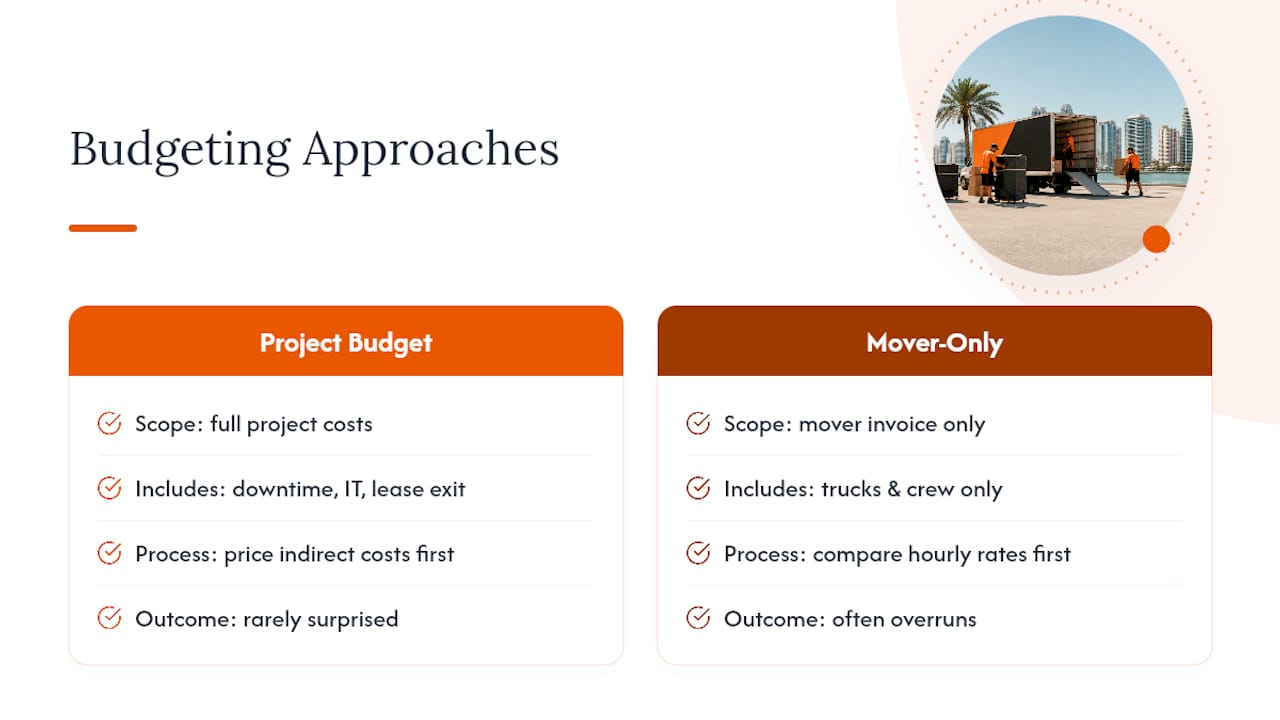
A moving company's invoice is only one line in a real office relocation budget. Downtime, IT reconfiguration, and lease exit obligations routinely add more to the true cost than the trucks and crew do, yet they rarely appear on the same page as the moving quote. That's backwards. Office managers who build their budget around desk count and square footage first, then layer the moving bid on top, end up far closer to their actual spend than those who request a mover's quote and treat it as the whole number.
The fix isn't complicated. Walk the space with your mover, document access constraints honestly, and price the indirect costs before you ever compare hourly rates. The businesses that budget this way rarely get surprised. The ones that skip it almost always do.
— Orange Movers Team
Ready for a Straightforward Office Moving Quote?
Orange Movers gives South Florida businesses something most commercial movers skip: a walkthrough quote before the truck ever shows up, so your number reflects your actual office instead of a generic estimate. From furniture wrapping and disassembly to careful handling of servers and IT equipment, our crews protect your space and your equipment from the first box to the last chair.

A free walkthrough quote covers your inventory, building access, and timeline, then hands you a written estimate with no vague line items. Whether you're relocating within Fort Lauderdale or moving across South Florida, our commercial moving services team can scope your job and give you real numbers instead of guesses. Ready to see what your move actually costs? Request your free office moving quote and get a written estimate before you set a moving date.
Sources
- Average Office Moving Costs
- How Much Does It Cost to Move an Office? Full cost breakdown
- Commercial moving company cost explained for offices, equipment, and business relocations
- Office Relocation Costs: Budget Guide 2026
FAQ
How much does it cost to move an office?
Most office moves cost $5,000 to $15,000, with small offices running as low as $750 and large or complex relocations exceeding $30,000. Your final number depends mainly on desk count, distance, and how much IT or specialty equipment needs handling.
How much should you tip movers on a $500 move?
Tipping isn't required, but it's customary in the moving industry for good service.
How much does it cost to hire movers for three hours?
Hourly crew rates typically range from $150 to $250 for a two-person crew and $400 to $700 for a larger crew with multiple trucks. Getting a specific hourly rate during your walkthrough quote is the only reliable way to know your exact number.
What is the cheapest day to hire movers?
Mid-week days, especially Tuesday through Thursday, tend to cost less than weekends because demand is lower. Scheduling outside peak weekend and month-end windows can reduce labor surcharges by roughly 10 to 15% in many markets.
Should a small business use professional movers or DIY?
DIY moving with rented trucks can save money upfront but shifts the risk of equipment damage, employee injury, and lost workdays onto your business. For most offices with servers, sensitive equipment, or more than a handful of desks, hourly labor-only assistance or a full-service commercial mover reduces downtime and protects equipment more reliably than a self-managed move.