
The best system for stair protection when moving is a soft cushioning base like a moving blanket or felt topped with a non-slip, waterproof layer such as self-adhesive carpet film or a rubber-backed runner, with railings wrapped separately. Secure every edge flat and taut. If your stairwell has tight turns, heavy furniture, or a finished historic staircase, hiring professional movers protects both the surface and the people carrying the load.
TL;DR:
- Proper stair protection involves layering a soft cushioning material with a non-slip, waterproof surface, secured tightly to prevent shifting or tearing during the move.
- Installing protection requires detailed measurements, careful application, regular inspection, and gentle removal to avoid creating trip hazards or damaging finishes.
- Wrapping railings and walls with padding and tape prevents surface damage, especially in historic or ornate stairwells, where preservation needs special attention.
- Different surfaces such as wood, carpet, or stone require tailored protection strategies, with impact and slip resistance being key considerations for each material.
- Professional movers use specialized equipment, technique, and disassembly to minimize damage, with costs increasing with the number of stairs, surface value, and item weight.
Table of Contents
- What Is the Best Way to Protect Stairs During a Move?
- How Do You Install Stair Protection Before Moving Day?
- How Do You Protect Railings and Walls While Moving?
- Which Stair Protection Works Best for Wood, Carpet, and Stone?
- How Do Professional Movers Protect Stairs Differently?
- What Does Stair Protection Cost for a Move?
- What Mistakes Ruin Stair Protection on Moving Day?
- When Should You Hire Movers Instead of DIY Stair Protection?
- Book Professional Stair Protection With Orange Movers
- Sources
- FAQ
What Is the Best Way to Protect Stairs During a Move?
Stair protection for moving comes down to layering, not just covering. A single sheet of plastic or cardboard on a tread may look like protection, but it slides, tears, and often does more harm than good once a 200-pound dresser scrapes across it.
The two-layer approach works better because each layer does a different job. The bottom layer absorbs impact from dropped boxes or a dolly wheel catching an edge. The top layer resists moisture, foot traffic, and abrasion from furniture corners. Professionals in the moving industry describe this combination the same way: a soft base like moving blankets or felt paired with a non-slip, moisture-resistant top layer is the standard for wood stairs specifically.
Here's how the common materials stack up:
- Moving blankets or felt pads absorb shock and prevent gouges from dropped items, but they're not waterproof or slip-resistant on their own.
- Self-adhesive carpet film creates a waterproof barrier that keeps carpet fibers clean without leaving adhesive residue, provided the label specifically says carpet-safe.
- Padded stair runners work well for repeated trips up and down because they stay in place better than loose film on high-traffic days.
- Multi-layer protection rolls, the kind contractors use on renovation jobs, combine flexibility, impact resistance, and water resistance and can be cut to fit individual treads and risers.
For tape, skip anything labeled "packing tape." It's built to bond permanently to cardboard, not to release cleanly from wood or paint. Painter's tape is the safer choice because it holds coverings in place without leaving sticky residue when you pull it off weeks later.
When you're buying materials, check four things before you check out: whether the adhesive is labeled carpet-safe or wood-safe, whether the top surface has texture or grip (thin plastic alone is a slip risk), the width and length compared to your actual tread depth and stair run, and whether the packaging claims "residue-free" removal.
Pro Tip: Buy more material than your measurements suggest, as stair protection often tears at corners and requires replacement mid-move more often than expected. Stair protection tears at corners and gets replaced mid-move more often than people expect, and running out on moving day means exposed treads for the rest of the job.
How Do You Install Stair Protection Before Moving Day?
Installing stair protection is a short job if you do it in order. Rushing the prep step is where most DIY jobs go wrong.
- Clean the stairs first. Sweep or vacuum every tread and riser. Grit trapped under a covering acts like sandpaper every time someone walks over it.
- Measure each tread, riser, and landing individually. Stairs are rarely uniform, especially in older homes, so cutting one universal template usually leaves gaps at the edges.
- Choose your material based on the surface. Wood gets a blanket plus film; carpet gets adhesive carpet film; stone or tile gets extra cushioning underneath the non-slip top layer.
- Lay the cushioning layer first, tucking it against the riser so it doesn't bunch when weight presses down.
- Apply the non-slip top layer over it, smoothing out air pockets and wrinkles as you go.
- Secure every edge with painter's tape, paying special attention to the nosing (the front lip of each tread), since that's where feet catch and where coverings peel first.
- Check the transitions between the top and bottom of the staircase and any landing, since uneven surfaces there are where people trip.
- Assign one person as a spotter on moving day whose only job is watching the stairs while others carry items.
- Inspect the coverings every hour, more often if the crew is making frequent trips, and replace any section that's torn, curled, or wet.
- Remove protection carefully once the move is done. Peel slowly from one edge rather than yanking, and check for adhesive residue before considering the job finished.
Why this matters: a covering that shifts, curls, or peels during a move stops being protective and becomes a tripping hazard, which is a bigger risk than the scratch it was meant to prevent. Secure installation and regular inspection aren't optional extras. They're the difference between protecting your stairs and creating a fall risk on the busiest day of your move.
How Do You Protect Railings and Walls While Moving?
Stairwells lose more paint and finish on the walls and railings than on the treads themselves, mostly because nobody thinks to protect them until a couch corner has already left a mark.
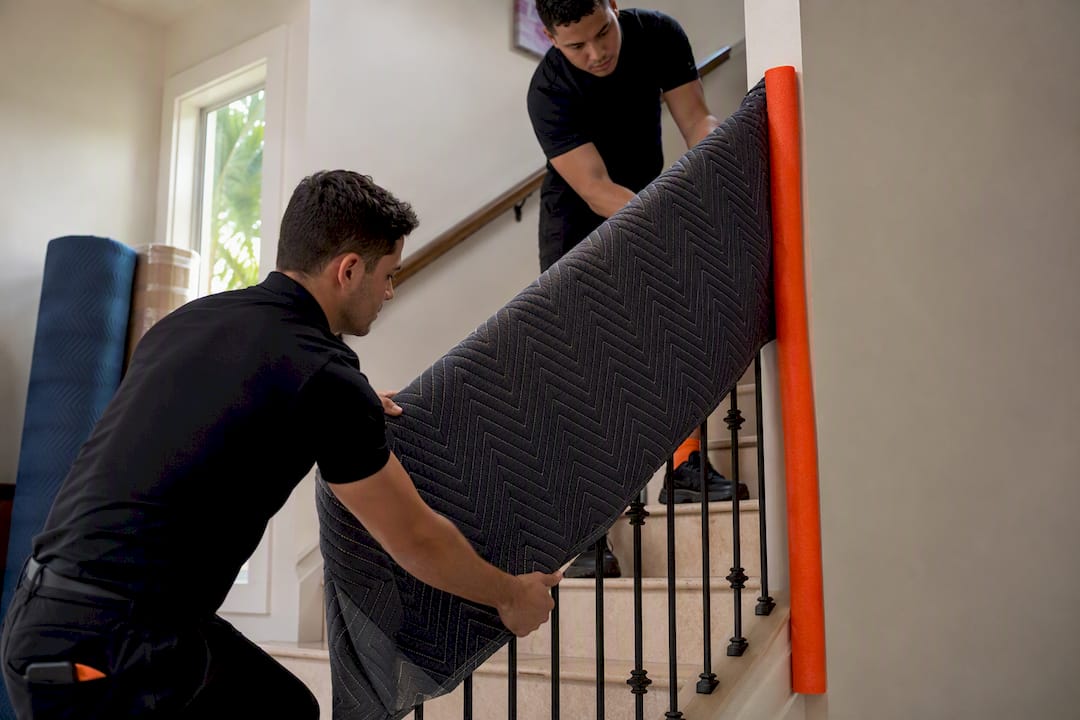
Wrapping the railing takes five minutes and saves a repaint. Moving blankets or bubble wrap secured with tape prevent the scratches that happen when bulky furniture gets maneuvered through a tight turn at the top or bottom of a flight.
A few specifics worth knowing before you start:
- Use painter's tape or protection-to-protection tape (tape that sticks to itself rather than the surface underneath) to secure wraps on railings and banisters.
- Cardboard corner guards work well on drywall corners at landings, where a dresser edge is most likely to catch.
- Temporary plywood sheets, held in place without fasteners, protect trim and baseboards in narrow hallways leading to the staircase.
- For antique or ornate banisters, avoid any adhesive that touches the original finish. Non-invasive blocking and padding, without screws or high-tack tape, are the safer route.
Older or architecturally significant staircases sometimes need a different standard entirely. Preservation guidance recommends assembling temporary plywood and padding without fasteners that damage original fabric, which is a more involved setup than a typical residential move requires but worth knowing about if your home has historic woodwork.
Which Stair Protection Works Best for Wood, Carpet, and Stone?
Not every staircase needs the same covering, and using the wrong one can cause the exact damage you're trying to prevent.
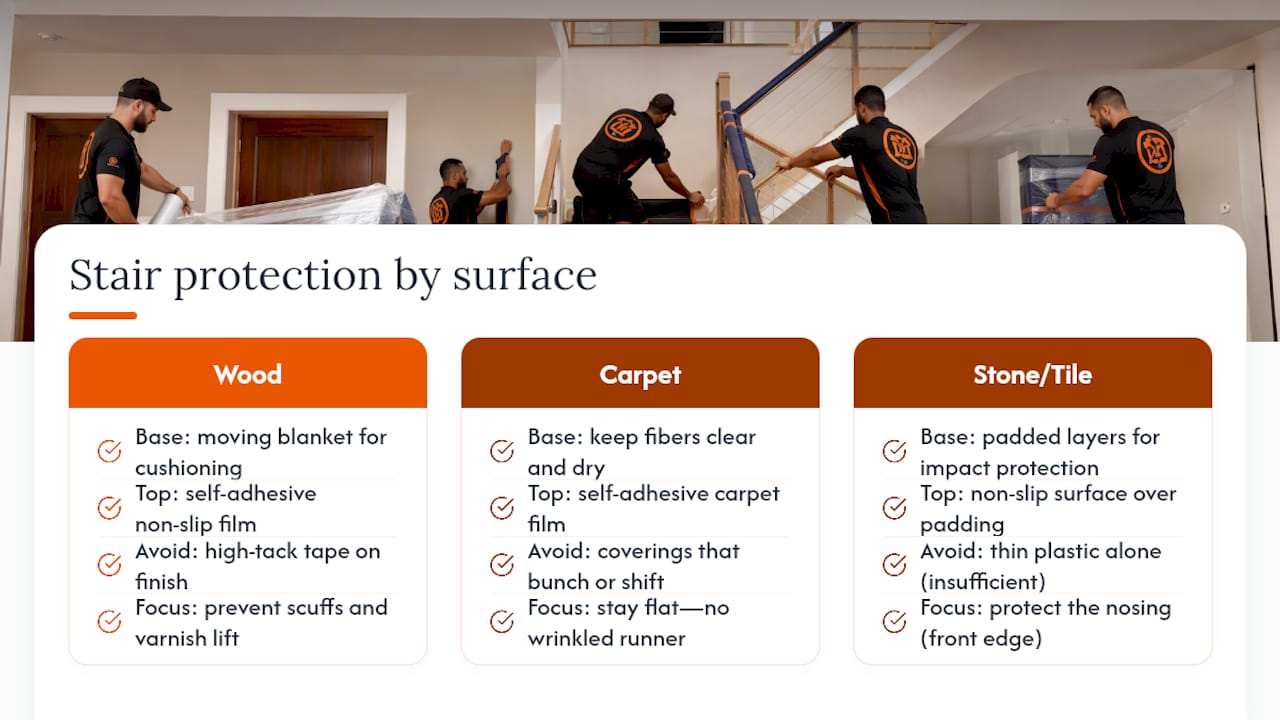
Wood stairs are the most finish-sensitive surface in most homes. A moving blanket for cushioning, topped with self-adhesive non-slip film, protects against both impact and scuffing. Never apply high-tack tape directly to wood. Even a few hours of contact can pull up varnish when you remove it.
Carpeted stairs need a different top layer entirely. Self-adhesive carpet film designed specifically for carpet keeps the fibers clean and dry without the residue problem that regular plastic sheeting can cause. Skip any covering that bunches or shifts underfoot. A wrinkled runner on carpeted stairs is one of the most common trip hazards on moving day.
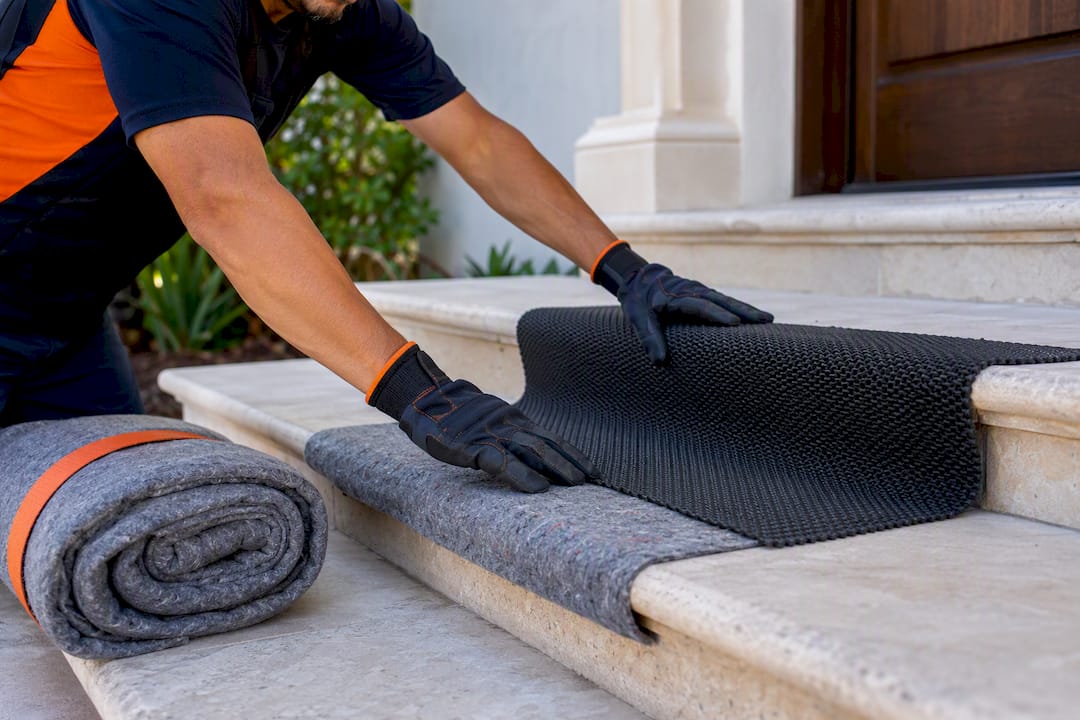
Stone and tile stairs look tough but chip easily at the nosing, the front edge of each step. Padded layers topped with a non-slip surface protect against impact, but thin plastic alone doesn't offer enough grip or cushioning for a heavy dolly pass. Pay particular attention to protecting the nosing itself, since that's where chips happen first.
When a staircase has real value at stake, whether that's a refinished hardwood original or a fragile antique surface, custom plywood systems and experienced crew handling are worth the extra planning. It's a lot easier to prevent a gouge than to fix one.
Pro Tip: A rubber or textured top surface beats thin plastic on every surface type. Slick plastic alone is genuinely more likely to cause a slip than provide meaningful traction, especially when treads get damp from rain tracked in during a move.
How Do Professional Movers Protect Stairs Differently?
Professional crews treat coverings as one part of a bigger system, not the whole solution. Technique matters just as much as materials, and it's the part homeowners rarely see until they've hired a crew and watched them work.
Equipment plays a real role here. Rubber-wheeled dollies distribute weight more evenly and grip better on covered stairs than standard hand trucks. Stair climbers, purpose-built for navigating flights with heavy appliances or furniture, remove a lot of the physical strain that leads to dropped items. For extreme cases, like a piano or a heavy safe, crews sometimes lay down masonite or plywood runners over the protective covering itself to create a rigid, predictable surface.
The workflow matters as much as the gear. Experienced crews assign a dedicated spotter for every stair trip, disassemble bulky furniture before attempting a tight turn, and stage loads to limit the number of trips up and down a flight, since fewer trips means less wear on both the coverings and the surface underneath.
- Rubber-wheeled dollies and hand trucks reduce scuffing compared to standard casters.
- Furniture straps let two movers share weight and control on turns, instead of one person forcing an awkward angle.
- Disassembling large items (bed frames, sectional sofas, bookshelves) before the stairs cuts down on the width and weight moving through tight spaces.
- Staging and rotating loads limits repeated heavy traffic on the same treads.
Professional crews often prioritize technique, spotters, disassembly, dollies with rubber wheels, over relying only on surface coverings. Coverings matter, but they're not a substitute for controlled handling on a tight turn or a narrow landing.
Technique becomes the deciding factor in situations coverings can't fully solve: a 90 degree turn at a landing, a piano that can't be tilted past a certain angle, or an antique staircase where even a small slip could crack century-old wood. Orange Movers' furniture disassembly and reassembly service exists specifically for these scenarios, breaking down bulky pieces so they move through stairwells safely instead of getting forced.
What Does Stair Protection Cost for a Move?
DIY stair protection is inexpensive. Carpet film, a padded runner, moving blankets, and a roll of painter's tape typically run somewhere in the range of a modest hardware store trip, and a single flight takes most people 20 to 40 minutes to cover properly if they measure first.
Professional protection costs more because it's bundled into labor, not sold separately. When a moving company protects your stairs, you're paying for materials plus the crew's time, technique, and insurance coverage, not just the covering itself.
A few things push the cost and time up or down:
- Number of flights. Multi-story homes multiply both material use and labor time.
- Finish value. Refinished hardwood or historic staircases justify slower, more careful (and pricier) protection methods.
- Weather. Rain means extra time spent on entryway protection and more frequent inspection of stair coverings for tracked-in moisture.
- Item size and weight. A piano or a large sectional sofa takes longer to protect for and move than standard boxes and furniture.
What Mistakes Ruin Stair Protection on Moving Day?
Most stair protection failures trace back to the same handful of errors, and nearly all of them are easy to avoid once you know what to watch for.
Loose or wrinkled coverings are the biggest offender. A runner that bunches at the edge of a tread doesn't just look sloppy. It's a trip hazard waiting for someone carrying a box who can't see their feet. Keep every layer flat and taut, and walk the stairs yourself before the move starts to check for soft spots or ripples.
Using packing tape on finished wood or carpet is the second most common mistake. It bonds too aggressively and often lifts finish or fibers when removed. If residue does happen, a gentle adhesive remover formulated for the specific surface works better than scraping.
On moving day itself, a few quick fixes handle most problems:
- Re-tape any edge that's starting to lift, especially at the nosing of each tread.
- Swap out torn or soaked sections immediately rather than moving on and hoping it holds.
- Keep one person checking the stairs periodically instead of assuming the morning's setup will last all day.
Pro Tip: Walk the entire staircase yourself, empty-handed, right before the first heavy item goes through. It's the fastest way to catch a loose edge before someone carrying a couch finds it for you.
When Should You Hire Movers Instead of DIY Stair Protection?
Homeowners can handle straightforward single-flight moves with basic materials and a careful eye. But some situations call for professional judgment: multi-story homes with tight turns, valuable or historic finishes that can't tolerate any margin for error, and heavy or awkward items like pianos, safes, or oversized furniture.
At Orange Movers, our crews prep stairwells before anything gets carried, using secured layering techniques and materials chosen for the specific surface, whether that's wood, carpet, or stone. Our floor, wall, and doorway protection approach treats stairs as a full system, not an afterthought. If you're unsure whether your stairwell needs professional handling, an estimate costs nothing and tells you exactly what to expect.
— Orange Movers Team
Book Professional Stair Protection With Orange Movers
Orange Movers gives you a faster, lower-risk path to protected stairs than piecing together DIY materials on a tight moving-day timeline. Instead of researching tape types and hoping your measurements hold, you get an experienced crew that arrives with the right protective materials already sized and ready for your specific staircase.

Our services cover the full stairwell system: floor, wall, and doorway protection, furniture padding and quilt-wrapping, and full-service packing that includes the protective materials your move needs from the first box to the last piece of furniture. Clients get trained crews who know how to secure coverings so they stay flat and safe for hours of foot traffic, not just the first ten minutes.
Whether you're moving a single-family home in Fort Lauderdale, a condo in Boca Raton, or a multi-story property anywhere across Broward, Miami-Dade, or Palm Beach County, Orange Movers can walk your stairwell before move day and tell you exactly what protection it needs. Get a free moving quote and find out what a professionally protected staircase looks like on your own move.
Sources
- How to Protect Stairs When Moving
- Trimaco carpet film product information
- Temporary protection of stairways (NPS technical note)
- Slip, trip and fall prevention guidance (WSU EHS)
FAQ
How Can I Protect My Stairs When Moving?
Use a soft cushioning layer, like a moving blanket or felt, topped with a non-slip, waterproof layer such as carpet film or a rubber-backed runner, and secure every edge with painter's tape so nothing shifts underfoot.
What Is the Best Carpet Stair Protector for Moving?
Self-adhesive polyethylene carpet film labeled specifically as carpet-safe works best, since it creates a waterproof barrier and keeps fibers clean without leaving adhesive residue behind.
What Do Movers Use to Protect Floors and Stairs?
Professional crews typically combine moving blankets or felt padding with non-slip, moisture-resistant top layers, plus rubber-wheeled dollies and furniture straps to reduce contact and impact during transport. Orange Movers uses this same layered approach as part of its floor and stairway protection process on every job.
What Is the 27 Rule for Stairs?
There's no widely recognized "27 rule" in professional stair-protection or moving guidance. If you've seen this referenced elsewhere, it likely refers to a building-code stair dimension standard rather than a moving or protection technique, and it's worth confirming the source before relying on it.
Is It Worth Hiring Movers Just for Stair Protection?
If your move involves multiple flights, a historic or high-value staircase finish, or heavy and awkward items, professional handling reduces both damage risk and physical strain compared to DIY coverings alone.